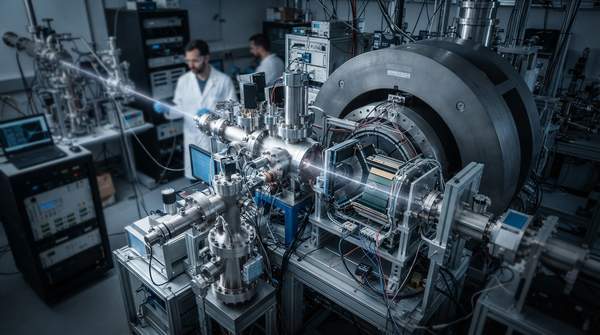
In a major step toward probing the limits of modern physics, researchers at ETH Zurich and the Paul Scherrer Institute (PSI) have developed a novel particle beam that will allow for a groundbreaking test of Albert Einstein's theory of gravity. By creating an intense, cold beam of an exotic atom called muonium, scientists plan to investigate for the first time whether gravity's pull is the same for a rare, "second-generation" particle as it is for the ordinary matter that makes up our world. The experiment directly probes the universality of free fall, a foundational principle of General Relativity that has never been verified for this type of matter.
The principle, a cornerstone of physics first recognized in the time of Galileo, states that all objects in a gravitational field fall at the same rate, regardless of their composition. While this idea has been confirmed with extraordinary precision for everyday matter and even first-generation antimatter, its validity for other types of particles remains an open and tantalizing question. This new experiment, conducted at the PSI's particle accelerator in Villigen, Switzerland, aims to fill that crucial gap in our understanding of the universe.
Generations of Matter and Gravity's Reach
At the heart of the new experiment is the distinction between the fundamental particles that constitute the universe. The Standard Model of particle physics organizes these building blocks into three "generations" of increasing mass. All stable, ordinary matter—from stars and planets to people—is made from first-generation particles. The new experiment uses muonium, an exotic, short-lived atom containing an antimuon, which is a heavier, unstable cousin of the electron and a member of the second generation. According to Anna Soter, a lead researcher on the project from ETH Zurich and PSI, testing how muonium falls is a novel way to probe one of physics' most fundamental rules.
The gravitational interaction of second-generation particles has never been directly measured, representing a significant gap in the experimental verification of Einstein's equivalence principle. The table below outlines the distinction between these particle types and the unique role of the new experiment.
| Particle Category | Description | Status of Gravity Test |
|---|---|---|
| First-Generation Particles | Includes electrons and the quarks that form protons and neutrons, making up all ordinary matter. | The universality of free fall has been extensively verified, confirming Einstein's equivalence principle for this type of matter. |
| Second-Generation Particles (e.g., Muonium) | Muonium is an exotic atom made of an electron and an antimuon. The antimuon is a second-generation particle, about 200 times more massive than an electron. | The gravitational interaction of second-generation particles has never been experimentally tested. This represents a significant gap in verifying the equivalence principle. |
| The New Experiment | Uses a newly developed "cold" and intense beam of muonium atoms to precisely measure their behavior in a gravitational field for the first time. | A result that deviates from General Relativity's prediction could imply the existence of new physics, such as a "fifth fundamental force." |