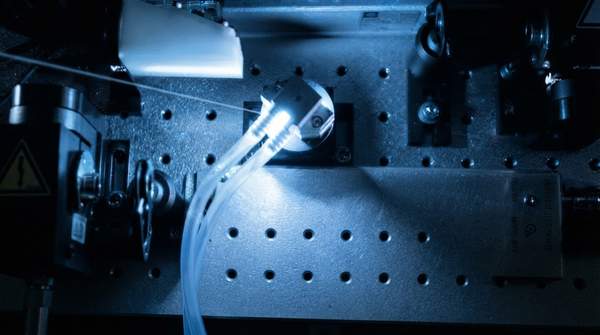
Next-generation particle accelerators are harnessing the power of plasma to achieve acceleration gradients orders of magnitude greater than conventional technologies. This method, known as plasma wakefield acceleration, uses a powerful driver to create a wave, or wake, in a plasma—an ionized gas of electrons and ions. A trailing bunch of particles can then "surf" this wake, rapidly gaining immense energy over very short distances. The two primary methods for creating this effect are distinguished by their driver: one uses an intense laser pulse, while the other employs a high-energy electron beam.
The Core Principle of Plasma Acceleration
In a plasma wakefield accelerator, a driver is sent through a plasma, which is a state of matter where atoms are stripped of their electrons, creating a mixture of free-moving negative electrons and positive ions. This driver displaces the plasma's lightweight electrons, pushing them aside while the heavier, positive ions remain relatively stationary. As the driver passes, these displaced electrons are pulled back toward the ion column by electrostatic attraction, overshooting their original positions and creating powerful oscillating waves of electric charge. This disturbance, known as a plasma wakefield, follows the driver much like the wake behind a boat. The wake contains regions of extremely strong electric fields that can be used to accelerate a second, trailing bunch of charged particles to very high energies in a fraction of the distance required by traditional radio-frequency accelerators.