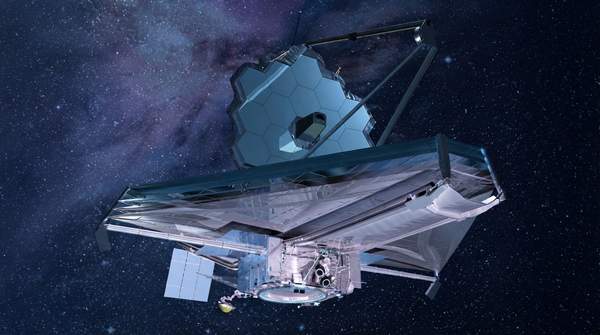
The James Webb Space Telescope observes almost exclusively in infrared light because the questions it was built to answer are, in many cases, physically invisible in any other part of the spectrum. The earliest galaxies are so far away that cosmic expansion has stretched their light toward the infrared; newborn stars and planets hide behind dust clouds that block visible light; and the chemical fingerprints of exoplanet atmospheres appear at infrared wavelengths. Webb's two workhorse instruments, NIRCam and MIRI, were designed to turn those physical facts into data.
Why Infrared: Unveiling the Universe's Hidden Secrets
Webb's mission goals, as summarized in its mission documentation, are fourfold: to search for light from the first stars and galaxies that formed after the Big Bang, to study galaxy formation and evolution, to understand star and planet formation, and to study planetary systems and the origins of life. The European Space Agency explains that these goals can be pursued more effectively in near-infrared light than in the visible spectrum, which is why Webb, unlike Hubble, does not measure visible or ultraviolet light.
The first reason is time itself. Because light takes time to travel, looking deeper into space means looking further back in time. And because the universe is expanding, the most distant objects are moving away from us fastest, redshifting their light. The first stars and galaxies are therefore seen not in the visible light they emitted, but stretched toward longer, infrared wavelengths.
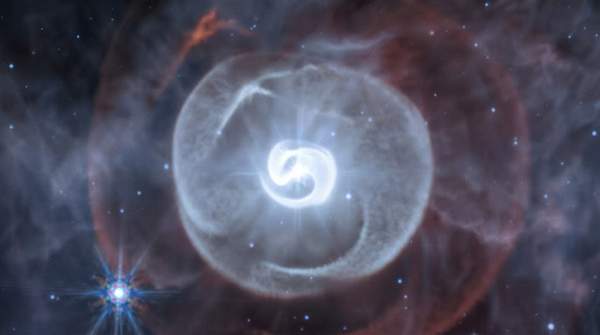
The second reason is dust. ESA notes that Webb's infrared vision allows it to study stars and planetary systems forming inside thick clouds of gas and dust that are opaque to visible light. NASA's infrared astronomy explainer describes the mechanism directly: dust absorbs ultraviolet and visible light and then re-emits it in the infrared. In Hubble's images, dark regions mark where starlight is absorbed by dust; in Webb's images, that same dust glows in infrared.
The third reason is temperature. As NASA puts it, some objects are simply better observed in infrared wavelengths—cooler cosmic objects radiate most of their light there rather than in visible light.
Why JWST Sees in Infrared: A Core Explanatory Model
The table below organizes Webb's primary scientific objectives by the physical principle that makes infrared observation necessary, and links each to the observational advantage it delivers. The pattern that emerges is that Webb's infrared design is not a preference but a requirement: each goal depends on light that is either redshifted, re-emitted by dust, or thermally radiated.
| Scientific Goal | Physical Principle | Instrument | Observational Advantage |
|---|---|---|---|
| Early universe: first stars and galaxies | Cosmological redshift from universal expansion | NIRCam (0.6–5 µm) | Captures light from the most distant, fastest-receding objects, stretched out of the visible range |
| Star and planet formation | Dust absorbs visible/UV light and re-emits in infrared | NIRCam and MIRI (5–28 µm) | Penetrates opaque gas and dust clouds where stars and planets are born |
| Exoplanet atmospheres | Molecules absorb and emit at characteristic infrared wavelengths | NIRCam and MIRI together (4–12 µm) | Spectroscopy detects molecular signatures such as water, methane, and carbon dioxide |
| Early universe dust enrichment | Warm dust around supernovae radiates in mid-infrared | MIRI | Reveals dust around stellar explosions, tracing how the early universe gained the raw material for stars and planets |
Read across the rows, the framework shows why no single wavelength band would suffice: the redshifted early universe, dusty stellar nurseries, exoplanet atmospheres, and supernova dust each demand a different slice of the infrared spectrum, which is why Webb carries instruments covering both the near- and mid-infrared.
NIRCam and MIRI: JWST's Infrared Eyes
Webb's two central infrared instruments divide the spectrum between them. NIRCam, the Near-Infrared Camera, covers wavelengths from roughly 0.6 to 5 microns and is used for high-resolution imaging and spectroscopy. MIRI, the Mid-Infrared Instrument, extends coverage from 5 to 28 microns, reaching the cooler, longer-wavelength regime where warm dust glows and many molecular signatures appear.
As the spectroscopy publication Spectroscopy Online reports, Webb's operation at the L2 Lagrange point provides a stable thermal and pointing environment that supports high-sensitivity infrared imaging and spectroscopy across this wide wavelength coverage. The two instruments are complementary rather than redundant: NIRCam captures the shorter-wavelength light of distant redshifted galaxies, while MIRI's mid-infrared range is where cooler material and a different set of atmospheric molecules reveal themselves.
Peering into Exoplanet Atmospheres with Spectroscopy
Webb's most celebrated exoplanet result illustrates how the instruments work in tandem. Researchers using Webb reported potentially detecting atmospheric gases around 55 Cancri e, an intensely hot rocky exoplanet located 41 light-years from Earth—a finding Spectroscopy Online describes as the strongest evidence yet for an atmosphere surrounding a rocky planet beyond our Solar System.
The technique is secondary-eclipse spectroscopy. The planet is observed as it passes behind its star, and astronomers compare the combined light of star and planet with the star's light alone; the difference reveals the planet's own thermal emission. To investigate 55 Cancri e, researchers used NIRCam and MIRI together to measure infrared light between 4 and 12 microns, a range in which gases such as carbon dioxide and carbon monoxide leave detectable imprints on the spectrum.
The significance is methodological as much as astronomical. Detecting an atmosphere on a rocky planet demonstrates that Webb's spectrographs can chemically characterize small worlds, not just gas giants. The same approach—searching for molecular signatures like water, methane, and carbon dioxide—defines how Webb hunts for atmospheric conditions that could be friendly to life, without making any claim about whether life itself exists there.
Tracing Cosmic Dust: MIRI's Role in Early Universe Enrichment
Webb's infrared eyes also answer a question about the universe's raw materials: where did all the dust come from? Dust is essential—it is the stuff from which stars and planets form—yet the early universe was initially poor in it. One leading explanation is that stellar explosions manufactured and dispersed dust, and MIRI has now provided observational support for that idea.
In July 2023, MIRI captured images of two Type II supernovae—SN 2004et and SN 2017eaw—in the galaxy NGC 6946, about 22 million light-years away. Those observations revealed significant amounts of dust around the supernovae, lending support, as Spectroscopy Online reports, to the idea that such stellar explosions were major contributors to the dust present in the early universe.
The connection to Webb's broader mission is direct. If supernovae in galaxies like NGC 6946 are producing dust today, similar explosions in the young universe could have seeded the material from which the first generations of stars and planets formed. MIRI's mid-infrared range is what makes this visible: warm dust radiates in exactly the wavelengths the instrument was built to detect.
Monitoring the Universe's Evolution
Continued observation with JWST's infrared instruments is essential for advancing our understanding of cosmic origins and the potential for life beyond Earth. The evidence so far—strongest-yet atmospheric evidence at 55 Cancri e, and dust-rich supernovae in NGC 6946—shows the instruments doing precisely what they were designed to do, but each result is a first step rather than a conclusion.
The measurable indicator of progress will be new data releases and scientific publications detailing atmospheric compositions of exoplanets and observations of high-redshift galaxies. For readers following the mission, those publications are the concrete milestones to watch: each confirmed atmosphere of a rocky world, and each dusty supernova or distant galaxy spectrum, extends the explanatory model above from design promise into documented discovery.