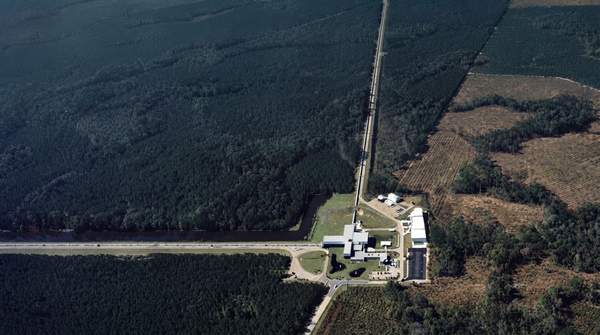
Gravitational waves are detected by measuring how they stretch and squeeze the arms of a giant laser interferometer. When a wave passes, one arm of the detector lengthens while the perpendicular arm shortens by a tiny amount. That difference changes how two halves of a split laser beam interfere when they recombine, and the resulting flicker of light is the signal. The effect is almost unimaginably small: MIT reports that in the first direct detection, on September 14, 2015, the interferometers were stretched by just one-ten-thousandth the diameter of a proton.
The Fabric of Spacetime and Gravitational Waves
What exactly is a gravitational wave? According to the LIGO Scientific Collaboration, gravitational waves cause spacetime to alternately stretch along one direction and compress in the perpendicular direction. A review of interferometric detection describes them as ripples in the curvature of spacetime that manifest as fluctuating tidal forces on any masses in their path.
Where do they come from? The same review identifies interacting black holes, coalescing compact binary systems, stellar collapses and pulsars as candidate sources. Because typical sources sit far from Earth, the stretching they produce here is extremely small, which is why a sophisticated device — the interferometer — is needed to measure it at all.
Why bother? Nearly everything astronomers knew before 2015 came from electromagnetic waves: visible light, radio and gamma rays. But as the LIGO Scientific Collaboration explains, electromagnetic waves are easily absorbed or scattered by matter between the source and us. Gravitational waves, by contrast, pass through all matter with very minimal absorption or scattering. That lets them reveal very distant objects and let us peer inside the sources that produced them.
That property is what makes this a genuinely new kind of astronomy. NASA's Space Place puts it simply: before the first detection, just about everything we knew about the universe came from studying waves of light; now we have a new way to learn about it — by studying waves of gravity. LIGO's announcement of the first observation, published on February 11, 2016, framed it as opening a new window on the universe, from colliding black holes in the distant universe.