Astronomers announced on November 19, 2026, the discovery of Welopōʻai, a triple-star system just 28 light-years from Earth whose close pairing of a red dwarf and a white dwarf appears to contradict standard predictions of stellar evolution. An international team led by the Trottier Institute for Research on Exoplanets at Université de Montréal detailed the find in a study published in the journal Astronomy & Astrophysics, calling it the closest known triple-star system containing two white dwarfs.
A Nearby Triple Star System Challenges Stellar Evolution
The discovery, described by Université de Montréal as extraordinary and one that challenges our understanding of how stars live, die and interact, was made by an international team of scientists led by the Trottier Institute for Research on Exoplanets. According to the university's announcement, Welopōʻai sits only 28 light-years away, making it a rare, close-up laboratory for testing ideas about how multi-star systems form and endure. No comparable system is known within 100 light-years of Earth, the researchers report.
Étienne Artigau, a researcher at the institute, captured why the find resonates beyond the specialist literature: "Discoveries like this remind us that our own cosmic neighborhood still contains remarkable surprises." The system combines a red dwarf — a small, faint star much dimmer than the Sun — with two white dwarfs, the dense remnants of stars that have exhausted their nuclear fuel. The team measured the mass of the newly identified white dwarf with an uncertainty of less than 1%, a precision that the announcement notes is rare and scientifically valuable.
Composition and Structure of Welopōʻai
Welopōʻai is arranged hierarchically, like many triple systems but with an unusual twist in its components. The inner pair consists of the red dwarf, designated Welopōʻai Aa, orbiting closely with the newly identified white dwarf, Welopōʻai Ab, which was detected with the Gemini North telescope's 'Alopeke instrument. A second white dwarf, Welopōʻai B, circles the entire inner pair at a much greater distance.
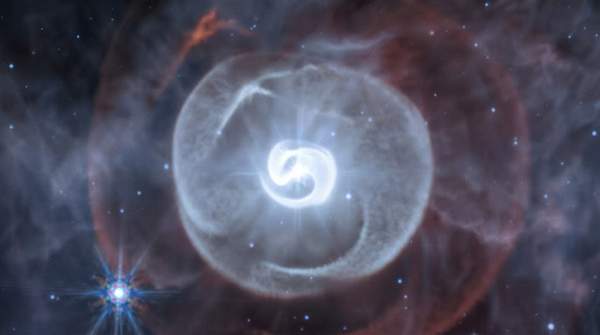
This combination is what sets the system apart. Triple systems are common in the galaxy, but ones containing two white dwarfs this close to Earth are not. The researchers confirmed Ab's presence by combining years of radial velocity measurements — which track how fast a star moves toward or away from us — with direct imaging observations. An artistic illustration of the system circulated with the announcement; the researchers note that it is not to scale.
The Astrophysical Puzzle: A System That 'Shouldn't Exist'
The heart of the discovery is not where the stars are now, but how they could have survived the path that led them there. Researchers estimate that the newly identified white dwarf was once a star about 40% more massive than the Sun. As such a star ages, it expands enormously — and according to the announcement, it may have grown large enough to make an intense interaction with its red dwarf companion inevitable.
In standard stellar evolution, that kind of engulfing interaction — a common-envelope phase, where the expanding star swallows its companion — is expected to destroy the smaller star or force the two to merge. Yet Welopōʻai presents precisely the opposite outcome: the red dwarf survived, and today it orbits closely and peacefully alongside the white dwarf remnant of the star that should have consumed it. The announcement frames this as "a puzzling survival" and "a system that shouldn't exist," because current models of this phase suggest the observed configuration should have been prevented.
Welopōʻai's Evolutionary Paradox
The contradiction at the core of the discovery can be laid out as a direct comparison between what models predict and what astronomers actually observed:
| Dimension | Expected from standard models | Observed in Welopōʻai |
|---|---|---|
| Progenitor star | A star about 40% more massive than the Sun | Became the white dwarf Welopōʻai Ab |
| Interaction with companion | Enormous expansion makes intense interaction with the red dwarf likely, leading to destruction or merger | The red dwarf Welopōʻai Aa survived the encounter |
| Resulting configuration | Close pairing of both stars in this state should not be possible | Red dwarf and white dwarf orbit close to one another, with a second white dwarf circling the pair |
| Comparative rarity | — | No comparable system known within 100 light-years of Earth |
The reasoning path is straightforward: standard models of the common-envelope phase predict that a companion engulfed by an expanding star is dragged inward, losing orbital energy and likely spiraling into a merger. Welopōʻai shows both stars still present and closely bound, meaning either the interaction unfolded in a way models do not capture, or the system's three-body dynamics somehow prevented the predicted catastrophe. The models' prediction, not the observation, is what now stands under scrutiny.
Implications for Stellar Evolution Models
The scientific value of Welopōʻai rests partly on measurement precision. By combining radial velocity data with direct observations, the team determined the new white dwarf's mass with an uncertainty of less than 1%. According to the announcement, mass measurements this precise, based on the stars' motion, are rare, and they enable scientists to test models of stellar evolution and understand how matter behaves at extreme densities — the physics inside a white dwarf, where a star's mass is compressed into an Earth-sized remnant.
White dwarfs are the final stage in the lives of most stars, including the Sun, yet the announcement notes that precise measurements of their masses remain scarce. Each well-characterized system therefore functions as a demanding check on theory. Universe Today's coverage similarly concluded that by determining the mass so accurately, the discovery will inform models of stellar evolution — a gap astrophysicists are keen to close.
Next Steps for Researchers
What astronomers do not yet have is a complete map of the three stars' orbits. The announcement describes the arrangement as an orbit yet to be mapped, and the team plans further observations to better chart how the stars affect one another through gravity. A leading possibility, as reporting on the discovery explains, is that over long periods an outer companion can alter an inner pair's orbit through gravitational interactions — but whether that happened here depends on orbital details the team has yet to measure. The researchers plan to investigate whether those dynamics can account for the red dwarf's survival; that answer remains open.
The discovery also touches a broader question that reporting on the find raises: the survival of planetary companions around stellar remnants, and what endures when a star changes dramatically. Welopōʻai joins a growing set of unusual stars that expose gaps between an observed system and its reconstructed past — in this case, in our own cosmic backyard.
A New Frontier for Stellar Evolution Research
The discovery of the Welopōʻai system necessitates a re-evaluation and refinement of current astrophysical models, particularly those governing common-envelope evolution and the long-term dynamics of multi-star systems. For researchers, it is a rare nearby test case: a red dwarf that should not have survived its companion's expansion, paired with a white dwarf whose mass is now pinned to within 1%.
The measurable indicator to watch is future publications detailing refined stellar evolution models or new observational data mapping the precise orbits and gravitational interactions within the Welopōʻai system. Until those orbits are charted, the question of how this system formed and survived — and what it forces theorists to rewrite — remains the discovery's defining open problem.
Sources
- Astronomers discover remarkable triple-star system just 28 light-years from Earth — UdeMnouvelles, l’actualité de l’Université de Montréal
- Astronomers discover remarkable triple-star system just 28 light-years from Earth — Phys.org
- A Triple Star System 'That Shouldn't Exist,' Only 28 Light-Years from Earth — Universe Today
- Astronomers find an unusual triple-star system located 28 light-years from Earth — The Brighter Side of News