Quantum technology is not just a futuristic concept; it's already a fundamental part of our daily lives. From the transistors in your computer to the lasers that scan your groceries, we are all beneficiaries of the first wave of quantum innovation. However, a second, more powerful wave is emerging, one that promises to revolutionize fields from medicine to computing. Understanding the difference between these two waves is key to grasping both the technology we have today and the profound challenges and opportunities that lie ahead.
The distinction, according to the University of Waterloo's Institute for Quantum Computing, lies in the level of control. The first wave of technologies relies on the collective, bulk quantum effects of countless particles. The second wave, in contrast, aims to precisely control and manipulate individual quantum systems, harnessing strange and powerful phenomena like superposition and entanglement to achieve unprecedented capabilities.
Quantum Technology Waves: A Comparative Overview
To understand the landscape of quantum technology, it's helpful to categorize applications into two distinct waves based on the level of control they require over quantum phenomena. This framework distinguishes between established technologies that harness the collective behavior of many particles and emerging applications that depend on the precise manipulation of individual quantum states.
| Characteristic | Wave 1: Bulk Quantum Effects | Wave 2: Single Quantum System Control |
|---|---|---|
| Level of Control | Relies on the collective, statistical behavior of many quantum particles. | Requires precise control over individual quantum systems. |
| Key Phenomena | Harnesses general quantum properties like energy levels and electron behavior in materials. | Exploits unique phenomena such as superposition and entanglement. |
| Examples | Lasers, transistors, MRI scanners, solar cells, and atomic clocks. | Quantum sensors, quantum computers, and secure quantum communication systems. |
| Development Status | Mature and ubiquitous in modern technology. | In various stages of research and development. |
| Primary Challenge | Refining manufacturing and improving efficiency of established principles. | Fully measuring, understanding, and controlling the states of complex quantum systems. |
Wave 1: Harnessing the Quantum Crowd
The first wave of quantum technology gave us the foundational tools of the modern world. These devices work because of quantum mechanics, but they don't require us to micromanage individual atoms or electrons. Instead, they leverage the predictable, collective behavior of vast numbers of them.
The transistor, the building block of all modern electronics, is a prime example. Its operation depends on the quantum properties of semiconductor materials. Similarly, lasers function by stimulating atoms to emit light of a specific wavelength, a process rooted in quantum principles. Medical imaging technologies like MRI scanners, the atomic clocks that make GPS possible, and even fluorescent lights all rely on these kinds of bulk quantum effects. These technologies are powerful and transformative, but they only scratch the surface of what quantum mechanics allows.
Wave 2: The Challenge of Individual Control
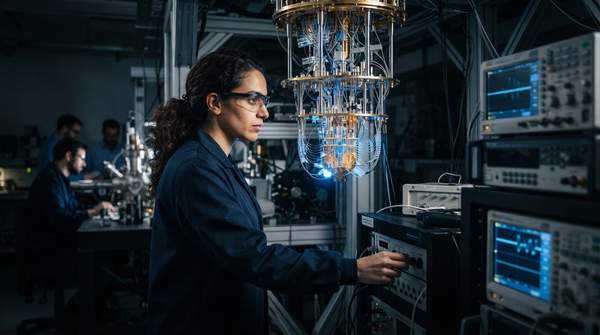
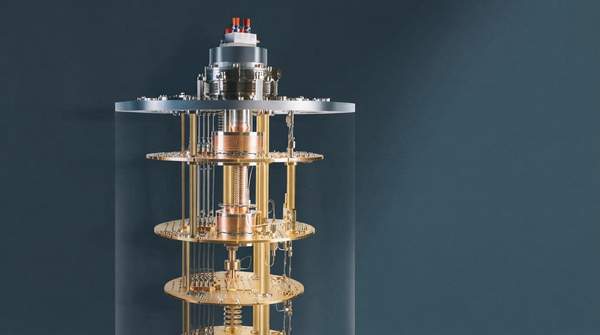
The second wave of quantum technology is a far more ambitious endeavor. It seeks to isolate, control, and measure the state of individual quantum systems. This is where phenomena like superposition (a particle existing in multiple states at once) and entanglement (the linked fate of two or more particles, no matter the distance between them) become powerful tools.
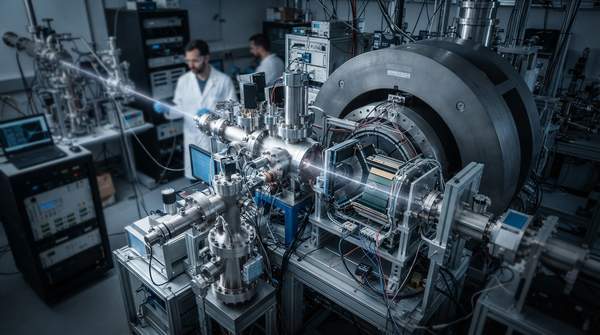
Quantum sensors are a leading example of this new wave. They are designed to exploit these unique quantum properties to detect extraordinarily weak signals, which could be vital for fundamental physics research. However, this precise control comes with immense difficulty. As these quantum systems are scaled up to become more complex and powerful, the task of fully measuring and understanding their quantum state becomes exponentially harder. This process can require enormous amounts of data and experimental time, creating a significant bottleneck for development.
Overcoming the Hurdles with AI
Researchers are actively developing new methods to overcome the challenges of controlling and characterizing these complex quantum systems. One promising approach involves using artificial intelligence to make the process more efficient. For instance, a Fermilab-led project known as QCVV, which stands for “AI-Guided Sparse Characterization of Quantum Sensing States and Entanglement Structures,” is designed to tackle this problem head-on.
The QCVV project aims to use AI to identify the most important and informative features of a complex quantum state. By creating a "digital twin" of the quantum system, researchers can pinpoint the most useful measurements to perform. This strategy avoids the brute-force method of trying to measure everything, a task that quickly becomes impossible for larger systems. By intelligently guiding the characterization process, researchers hope to accelerate the development of practical quantum sensors and other second-wave technologies.
The Future Frontier: What Wave 2 Promises
Successfully navigating the challenges of this second quantum wave could unlock transformative applications across society. While still in development, these technologies hold the potential to solve problems that are currently intractable. According to the CERN & Society Foundation, quantum computing could help design more efficient wind farms to maximize renewable energy or improve food security through advanced genetic editing of plants.
In other areas, quantum simulation could be used to design new materials or discover new drugs. Quantum communication, using principles like entanglement, might one day secure important documents with cryptographic keys that are fundamentally unbreakable. From optimizing energy to enabling new discoveries in fundamental science, the precise control offered by second-wave quantum technologies represents a new frontier of innovation.
Navigating the Quantum Frontier
The journey from the established technologies of the first quantum wave to the potential of the second is marked by a fundamental shift from harnessing collective effects to mastering individual quantum systems. The primary obstacle is the immense difficulty of characterizing and controlling these delicate and complex states. To move forward, the most critical task is to focus research and development efforts on advanced characterization and control techniques for individual quantum systems to accelerate the practical application of Wave 2 technologies. Progress can be tracked by a clear, measurable indicator: increased efficiency in quantum system calibration and reduced error rates in quantum sensing experiments, as demonstrated by projects like Fermilab's QCVV initiative. Success in this area will determine how quickly the revolutionary promise of quantum sensing, computing, and communications becomes a reality.
Sources
- Quantum applications today | Institute for Quantum Computing — Uwaterloo
- Real Life Applications of Quantum Mechanics - GeeksforGeeks
- Five Practical Uses for "Spooky" Quantum Mechanics — Smithsonian Magazine
- How Are Quantum Phenomena Used in Technology Today? — Caltech Science Exchange
- Fermilab to lead two new Genesis Mission awards to accelerate development of microelectronics and quantum — News
- shaping society’s future – CERN & Society Foundation — Cernandsocietyfoundation