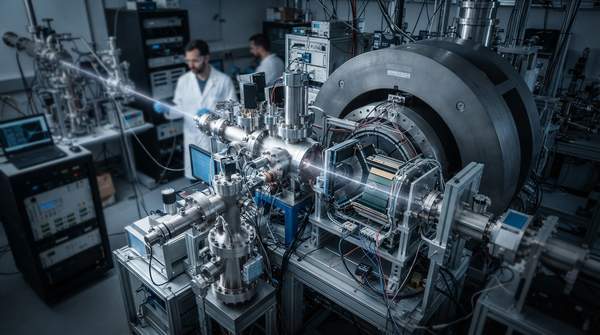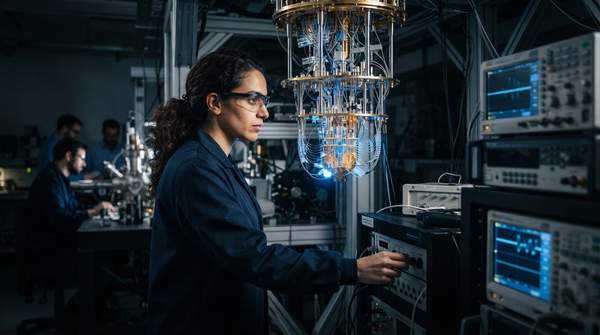
In a landmark experiment announced on September 25, 2026, physicists at the University of Oxford have demonstrated the ability to stop a quantum particle in its tracks using a magnetic field it never physically entered. By employing a hybrid quantum computer, the research team observed a foundational quantum phenomenon in an entirely new context, a breakthrough that could unlock new methods for simulating the fundamental interactions of the universe.
The experiment provides a powerful new demonstration of the Aharonov-Bohm effect, a counterintuitive principle of quantum mechanics. According to the University of Oxford Department of Physics, their quantum simulation showed a particle’s ability to "tunnel," or pass through a barrier, could be completely suppressed by the distant influence of a magnetic field. This achievement not only confirms a long-held theory in a novel setting but also showcases the growing power of quantum computers to tackle physics problems beyond the reach of even the most powerful classical supercomputers.
Quantum Tunneling and the Aharonov-Bohm Effect
In the familiar world of classical physics, an object must directly encounter a force to be affected by it. Quantum mechanics, however, operates under different rules. One of its most famous quirks is "quantum tunneling," where a particle can pass through an energy barrier that it classically should not have enough energy to overcome. It’s as if a ball could appear on the other side of a hill without ever rolling over the top.
The Aharonov-Bohm effect, first predicted in 1959, adds another layer of strangeness. It describes how a charged particle is influenced by a magnetic field contained within a region the particle never enters. Instead of passing through the field, the particle travels around it. Even so, the "potential" of the field alters the particle's quantum state, specifically a property known as its phase. This effect reveals that in the quantum realm, the electromagnetic potential is more fundamental than the fields themselves.
The Oxford Experiment: Stopping a Particle Without Touching It
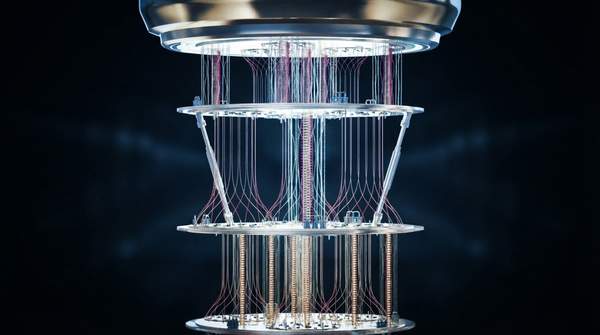
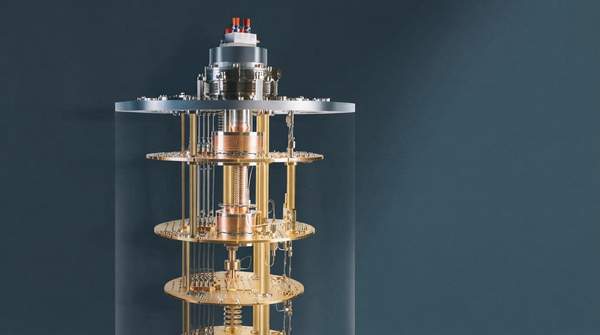
To explore this phenomenon, the Oxford physicists used a hybrid quantum computer, a machine combining the properties of qubits and quantum oscillators. In their simulation, they created a scenario where a matter particle could tunnel between two locations. Initially, with no magnetic field present, the particle tunneled freely between the points, as quantum mechanics would predict.
The crucial step came when the researchers introduced a magnetic flux—a contained magnetic field—in an area between the two locations that the particle’s path would encircle but not cross. The effect was immediate and absolute. The particle stopped tunneling altogether. According to the university's announcement, the system was "frozen in its starting state." The mere presence of the inaccessible magnetic field was enough to completely halt the particle's movement, demonstrating the Aharonov-Bohm effect with stunning clarity.
How a Particle's Paths Cancel Out
The mechanism behind this seemingly impossible result lies in the wave-like nature of quantum particles and a process called destructive interference. The simulation shows how the magnetic field forces a particle to interfere with itself, effectively preventing its own movement.
- Potential to Tunnel: In the absence of a magnetic field, a quantum particle has a certain probability of tunneling from a starting point to an endpoint. Its potential paths allow it to make this jump.
- Splitting into Two Paths: When a magnetic flux is placed in the middle, the particle, behaving like a wave, simultaneously explores the two possible paths around the flux to get to the other side.
- The Phase Shift: According to the Aharonov-Bohm effect, the magnetic flux alters the quantum phase of the particle as it traverses these paths. Crucially, the phase shift is different for each path.
- Destructive Interference: When the two paths recombine at the destination, their altered phases are now out of sync. They interfere destructively, meaning the peaks of one wave path align with the troughs of the other, canceling each other out.
- Tunneling Suppressed: Because the two possible routes for the particle have perfectly canceled each other, the probability of the particle appearing at the destination drops to zero. The tunneling is completely suppressed, and the particle remains in its initial location.
Novelty: Dynamical Setting and Lattice Gauge Theory
While the Aharonov-Bohm effect has been confirmed before, the Oxford experiment is significant because it was observed in a "dynamical setting" within a "lattice gauge theory." These concepts are central to how physicists model the fundamental forces of nature.
A lattice gauge theory is a framework that describes the interactions between matter particles and force-carrying fields on a discretized, grid-like version of space-time. This approach is particularly powerful for studying complex systems, such as the strong nuclear force that binds quarks together inside protons and neutrons. The common element in these theories is a gauge field, which mediates interactions between matter.
What makes the Oxford experiment novel is its use of a "dynamical" gauge field. In previous experiments, magnetic fields were often treated as a fixed, static background. In this simulation, however, the gauge field encoding the magnetic flux and the matter particle were part of the same interactive system, evolving together. This is a much more realistic simulation of how fundamental interactions occur in nature and is a key step toward using quantum computers to solve problems in high-energy and particle physics.
Next Steps in Quantum Simulation
The successful demonstration at Oxford, published in Nature Physics alongside related work from a group at the University of Maryland, signals a new capability for quantum computers. These studies highlight the potential of hybrid quantum systems to simulate fundamental interactions that are too complex to model accurately on classical computers. By creating controllable quantum environments, scientists can directly probe the theories that describe the building blocks of the cosmos.
Researchers should continue exploring hybrid quantum architectures for simulating complex physical phenomena, particularly those described by lattice gauge theories. The next milestone will be future research papers or announcements detailing new simulations of fundamental interactions using similar quantum computing approaches.
Sources
- Hybrid quantum computer observes foundational quantum effect in a new setting — University of Oxford Department of Physics
- Hybrid quantum computer observes foundational quantum effect in a new setting — Phys.org
- Hybrid quantum computer observes foundational quantum effect in a new setting — EurekAlert!
- Visualizing dynamics of charges and strings in (2 + 1)D lattice gauge theories - Nature
- PURE