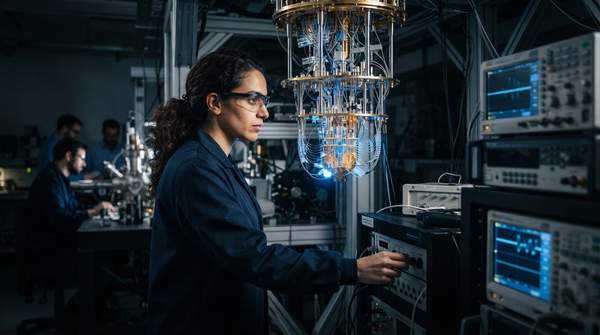
Physicists at the University of Oxford have developed a novel hybrid quantum computer that successfully simulated a foundational, and famously counterintuitive, quantum effect. The achievement, detailed in a paper published in Nature Physics, marks a significant step forward in using quantum devices to model the fundamental interactions between matter and energy, a class of problems that remains largely intractable for even the most powerful classical supercomputers.
The new machine combines two distinct types of quantum components—qubits and quantum oscillators—to create a more powerful and efficient framework for simulation. Using this system, the research team observed the Aharonov-Bohm effect, a phenomenon where a charged particle is affected by a magnetic field it never physically enters. This demonstration provides a powerful new tool for exploring the complex mathematical landscape of lattice gauge theories, which are essential to understanding particle physics.
A Ghost in the Machine: The Aharonov-Bohm Effect
At the heart of the Oxford experiment is one of the most profound and subtle effects in quantum mechanics. The Aharonov-Bohm effect, first predicted in 1959, describes how a quantum particle can acquire a measurable phase shift when it travels around a magnetic flux, even if its path is confined to a region with zero magnetic field. It's as if the particle "feels" a field that is somewhere else, a purely quantum interaction with no classical equivalent.
To observe this in a new setting, the physicists used their hybrid system to simulate the interaction. According to a report on the work, they encoded a magnetic flux within entangled qubits. This created a scenario where a simulated matter particle had two potential paths around a loop. The presence of the "unseen" flux caused destructive interference between the two paths, which, as a result, completely suppressed the particle's ability to tunnel from one point to another. This successful simulation of a cornerstone quantum principle validates the hybrid computer's ability to model the intricate rules governing matter and gauge fields.
How Oxford's Hybrid Quantum Computer Models Reality
The key innovation behind the Oxford team's success is the computer's hybrid architecture. To model the universe, physicists often use a framework known as a lattice gauge theory, which simplifies space into a grid of points connected by links. The challenge is representing both the matter that sits at the points and the force fields that operate along the links. The Oxford computer solves this by assigning each task to a different type of quantum component.
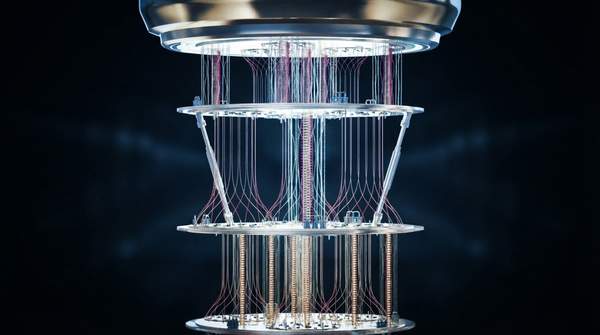
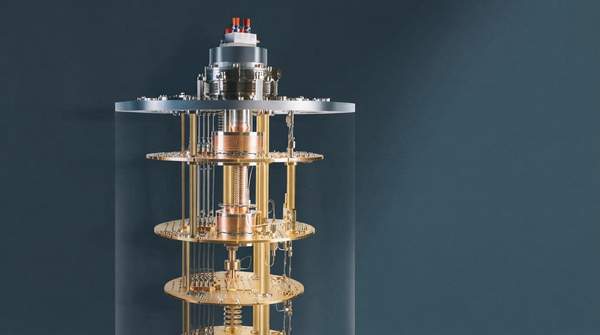
An artist's illustration released by the university helps visualize this concept, using the analogy of "spinning tops" and "springs" to form the repeating lattice pattern studied in the experiment. The qubits, analogous to spinning tops, represent the matter particles. The quantum oscillators, acting like springs, represent the gauge fields that connect them. By combining these two elements, the system can directly simulate the complete interaction between matter and the forces that govern it.
| System Component | Analogous Object | Role in Simulation |
|---|---|---|
| Qubits | Spinning Tops | Represent matter particles located at the grid points of the simulated lattice. |
| Quantum Oscillators | Springs | Represent the gauge fields that exist on the links connecting the matter particles. |
Beyond Classical Limits: The Advantage of Hybrid Quantum Systems
This hybrid approach was developed to overcome a fundamental barrier in computational physics. While lattice gauge theories are powerful, solving their equations for systems of "strongly interacting fermions and bosons" is beyond the capacity of classical computers. The complexity of these quantum interactions grows exponentially, quickly overwhelming conventional machines. The research paper notes that these problems can also be out of reach for non-error-corrected quantum computers that rely on qubits alone.
The Oxford team's framework, however, is described as being so efficient that it could simulate some of these complex problems even without error correction. The paper explains that this hybrid method allows for the exact decomposition of higher-order interactions between fermions and bosons, including notoriously difficult problems like (2+1)D gauge theories. The researchers assert that their work demonstrates a "post-qubit quantum advantage," tackling a problem that is intractable for both classical computers and near-term, qubit-only quantum devices.
Next Steps for Hybrid Quantum Computing
With this successful demonstration, the next step is to apply this hybrid quantum computing approach to more complex simulations and potentially scale the system, moving beyond qubit-only quantum computing architectures. The efficiency and power of this new framework open a promising avenue for research in high-energy physics, condensed matter, and other fields that depend on understanding the fundamental interactions of the universe. Future progress in the field can be tracked through the publication of new research detailing more complex simulations or advancements in the scaling of hybrid quantum systems.
Sources
- Hybrid quantum computer observes foundational quantum effect in a new setting — University of Oxford Department of Physics
- Quantum Meet Quantum: Hybrid Quantum Computer Lets Scientists Peak in on Foundational Quantum Effect — The Quantum Insider
- Hybrid quantum computer observes foundational quantum effect in a new setting — EurekAlert!
- INSPIRE — Inspirehep