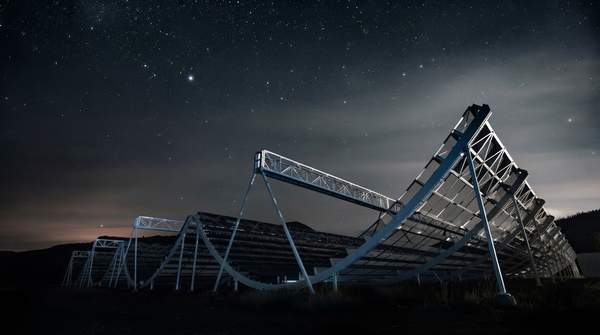
The Canadian Hydrogen Intensity Mapping Experiment (CHIME) radio telescope is charting the universe's expansion history by observing faint radio signals emitted by hydrogen gas. This innovative approach, known as Hydrogen Intensity (HI) Mapping, allows astronomers to create large-scale maps of the cosmos and investigate the mysterious force of dark energy, which is believed to be accelerating the universe's expansion.
CHIME's methodology offers a faster and more cost-effective way to survey vast cosmic volumes compared to traditional methods. By focusing on the distribution of hydrogen and leveraging Baryon Acoustic Oscillations (BAO) as a cosmic "standard ruler," CHIME provides a unique window into the early universe and its evolution, offering independent results that can help resolve contradicting theories about dark energy.
Unveiling Cosmic Expansion with CHIME
The CHIME telescope, a collaborative project involving scientists from the University of British Columbia, McGill University, the University of Toronto, the Dominion Radio Astrophysical Observatory, and other North American institutions, was specifically designed to map the distribution of hydrogen gas in the early universe. This mapping allows astronomers to calculate the universe's expansion rate and investigate dark energy, the enigmatic force thought to be driving the universe to expand at an ever-increasing pace.
By observing hydrogen, the most common element in the universe and the raw material for star formation, CHIME aims to reconstruct the universe's expansion history. This endeavor is crucial for testing competing models of dark energy's behavior and addressing one of the biggest open questions in physics. The telescope's ability to directly map the earliest glow of hydrogen paves the way for a faster, less expensive method to study this cosmic mystery.
Hydrogen Intensity Mapping: CHIME's Observational Technique
CHIME employs a technique called Hydrogen Intensity (HI) Mapping to observe the universe. Instead of resolving individual galaxies, CHIME detects the combined radio glow emitted by neutral atomic hydrogen gas across vast cosmic distances. This faint emission, specifically the 21-centimeter (21cm) radio line, allows the telescope to create a three-dimensional map of the universe's large-scale structure.
This method enables CHIME to map the distribution of hydrogen between redshifts of 0.78 and 1.43, corresponding to a period when the universe was between approximately 2.5 and 7 billion years old. The CHIME Collaboration has reported the first 21cm intensity mapping measurements made with an interferometer, constraining the effective clustering amplitude of neutral hydrogen. The ability to isolate and map this hydrogen signal independently, without relying on other surveys to pinpoint locations, marks a fundamental achievement for the telescope, as reported by researchers examining the observed signal.
This technique is well-suited for measuring structure on large physical scales because it avoids reliance on the complicated physics of galaxy formation, as individual galaxies are not resolved and counted. This makes CHIME's measurements of large-scale structure more direct and less prone to astrophysical uncertainties inherent in galaxy surveys.