
Dark Energy
4 articles
What Is the Universe Made Of? The Standard Model and the Cracks DES and DESI Are Opening in It
The standard cosmological model states the universe is composed of 5% normal matter, 27% dark matter, and 68% dark energy. However, recent findings from the Dark Energy Survey (DES) and Dark Energy Spectroscopic Instrument (DESI) are revealing cracks in this model, particularly concerning the behavior of dark energy.
Dark Matter vs. Dark Energy: Two Invisible Rulers of the Cosmos
Dark matter and dark energy, comprising over 95% of the universe, are distinct invisible forces. Dark matter acts as cosmic glue, holding galaxies together through gravity, while dark energy drives the accelerated expansion of space.
Dark Energy: The Unseen Cause of the Universe's Accelerating Expansion
Dark energy is the mysterious phenomenon driving the universe's accelerating expansion, inferred from distant supernovae observations. Despite the cosmological constant being the leading explanation, a vast theoretical discrepancy with quantum physics remains a profound puzzle.
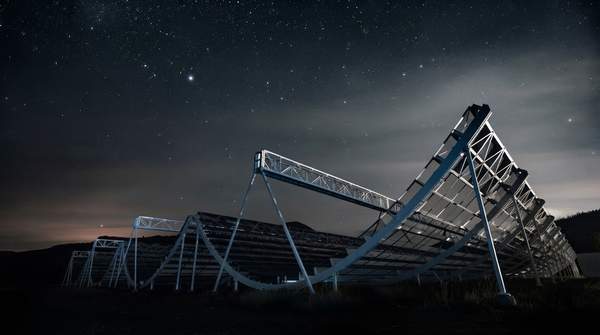
Mapping Cosmic Expansion with CHIME's Hydrogen Signals
The Canadian Hydrogen Intensity Mapping Experiment (CHIME) uses Hydrogen Intensity Mapping to observe faint radio signals from hydrogen gas, charting the universe's expansion history and investigating dark energy. This innovative technique leverages Baryon Acoustic Oscillations as a cosmic standard ruler, offering a faster, more cost-effective alternative to traditional galaxy surveys.