In the search for life beyond Earth, scientists evaluate planets orbiting distant stars using a multi-step assessment that examines the star, the planet's orbit, and the planet's physical characteristics. This process allows researchers to classify thousands of known exoplanets and prioritize the most promising candidates for further study. The central question is not whether life exists, but whether a planet has the fundamental conditions necessary for life as we know it, primarily the potential for liquid water on its surface.
Determining this potential involves more than just finding a rocky planet of a certain size. According to research published in Frontiers, key parameters include a planet's radius, mass, and density, as well as its star's temperature and luminosity. These factors are interdependent; a planet's distance from its star is critical, but the type of star it orbits fundamentally changes the equation for habitability. By systematically analyzing these criteria, astronomers can move from simple detection to a nuanced classification of a world's life-hosting potential.
Exoplanet Habitability Assessment Framework
Scientists assess an exoplanet's potential to host life by working through a framework of interconnected factors. This process moves from the broad environment of the star system down to the specific properties of the planet itself, with each step refining the possibility of habitability.
Stellar Factors: The Parent Star
The journey begins with the host star, as its properties dictate the environment for any orbiting planets. A star's type, luminosity, and lifespan are critical. According to NASA, K-dwarf stars are considered to be in a "sweet spot" for habitability. These stars have properties intermediate between our sun (a G-type star) and the more numerous but dimmer red dwarfs (M-type stars). K-dwarfs offer a balance of longevity and stable energy output, providing a long and consistent window for life to potentially emerge and evolve.
Orbital Factors: The Habitable Zone
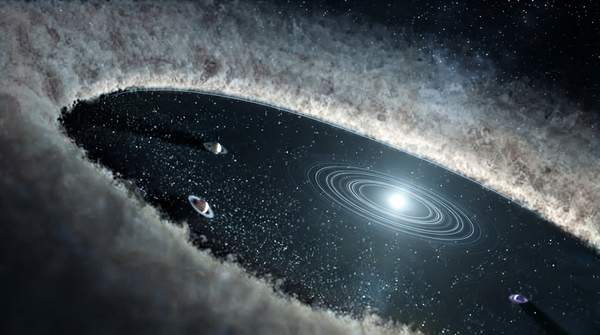
Once the star's characteristics are understood, the next step is to determine the location of its "habitable zone." This is the orbital region around a star where conditions are right for a planet to maintain liquid water on its surface—a factor widely considered the most important for habitability. The size and distance of this zone are not fixed; they depend directly on the star's size and luminosity. A brighter, hotter star will have a habitable zone that is farther out and wider than that of a cooler, dimmer star. A planet must orbit within this specific range to have a chance at maintaining a surface temperature suitable for oceans, lakes, or rivers.
Planetary Factors: Size, Mass, and Composition
Finally, the planet's own characteristics are evaluated. Key among these are its size, mass, and density. According to the Planetary Habitability Laboratory at the University of Puerto Rico at Arecibo, a planet's density can help scientists infer its composition and determine if it is a terrestrial, or rocky, world. This is a crucial distinction, as gas giants are not considered candidates for surface life. A planet's mass and radius are also important for its ability to retain an atmosphere and drive geological activity, both of which are thought to contribute to a stable, life-friendly climate over long timescales.