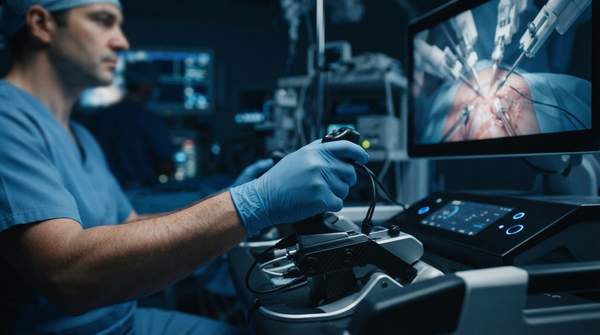
A surgical robot does not operate on its own. In the dominant "master–slave" design used today, the surgeon sits at a console — the master — and the machine translates every hand, wrist, and finger movement into real-time, scaled, and tremor-filtered motion by instruments inside the patient — the slave. Understanding that loop is the key to understanding how these systems achieve precision and dexterity through tiny incisions. This article breaks the robot into its three core subsystems — vision, control, and mechanical — and traces the signal from the surgeon's hand to the instrument tip.
The Master-Slave Paradigm: An Overview
Mayo Clinic staff describe a typical robotic surgery setup as a camera arm plus mechanical arms with surgical instruments attached, all directed by a surgeon seated at a console near the operating table. What makes this arrangement powerful is the division of labor. The surgeon supplies judgment and intent; the machine supplies steadiness, range, and scale.
A review of medical robotics in the PMC research library identifies the master–slave control architecture as one of the defining technologies of platforms like the da Vinci line, alongside multi-degree-of-freedom wristed instruments and 3D vision augmentation. In other words, the three subsystems are not independent gadgets. They form a closed loop: the surgeon watches a magnified view of the surgical site, moves the controls, and the arms respond. Change any one element and the others shift in meaning — which is why we treat the robot as a single system rather than a parts list.
The Surgical Robot's Master-Slave Control Loop
To see how a large hand movement becomes a tiny, stable instrument movement, follow one intended action through the system's four stages. This is the sequence described across clinical and technical sources, gathered here as a single working model.
- Surgeon input at the console. The surgeon grips the console controls and performs a movement. UCLA Health's patient guide describes master controls at the surgeon console that direct the instruments throughout the procedure — the surgeon remains in control the whole time, and the system only responds to the direction provided.
- Control system processing. A computer translates those movements in real time. New England Wire Technologies, a supplier of the underlying motion components, explains that advanced motion-control software converts the surgeon's hand movements at the console into scaled instrument movements inside the patient — dampening unintended motion along the way, as tremor-filtering accounts describe.
- Robotic arm execution. The processed signal drives compact servo motors, miniature actuators, encoders, and gearing in the arms, moving the wristed instruments with fine resolution.
- Visual feedback. High-definition cameras return a magnified, stereoscopic view of the result, and the surgeon corrects the next movement — closing the loop.
The result of this chain is the machine's defining capability: a surgeon's broad, natural gesture reappears at the instrument tip as a small, steady, deliberate motion.