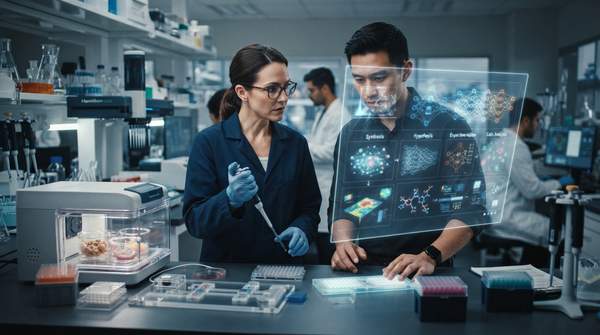
Artificial intelligence is now touching every stage of the scientific method, but not every AI tool belongs at every stage. Large language models triage literature and propose hypotheses; generative models emulate physical systems; domain-specific foundation models predict gene interactions and molecular properties. The practical question for a researcher is not which model is "best" but which class of tool matches the task at hand—reading the literature, generating ideas, or running simulations. This article maps those categories to the research stages they accelerate, explains how LLM-based hypothesis generation works and where it fails, and examines where the field is heading.
AI in Scientific Discovery: An Overview
A survey of the landscape by Cornell researchers notes that LLMs are beginning to accelerate core stages of scientific discovery, "from literature triage and hypothesis generation to computational simulation, code synthesis, and even autonomous experimentation." The same survey points to systems like ChemCrow, autonomous "co-scientists," and a Virtual Lab for nanobody design that couple language reasoning to domain tools, laboratory automation, and embodied systems to plan, execute, and interpret experiments.
A perspective published in npj Artificial Intelligence by Yanbo Zhang and colleagues strikes a cautionary note: AI's impact on fundamental science—defined there as the discovery of new principles or new scientific laws—has so far been limited. Their review treats LLMs as a technological tool that augments the scientific process rather than replaces it. That framing matters. These tools assist researchers; they do not autonomously produce scientific laws.
AI's Role Across the Scientific Method
The table below organizes the main categories of AI application by the research stage they serve, the core function they perform, and the key mechanism or challenge that defines their use.
| Scientific Stage | AI Application Type | Core Function | Key Challenge / Mechanism |
|---|---|---|---|
| Literature synthesis | LLMs for text analysis | Identify patterns across publications and suggest research directions | Depends on LLMs' ability to process and understand vast amounts of text |
| Hypothesis generation | LLMs as "creative engines" | Propose novel research hypotheses | Reliability; grounding via knowledge-graph augmentation |
| Simulation | Generative models for physical systems | Accelerate computational simulation and enable more reliable estimates | Training techniques that boost emulator performance with less data |
| Experimentation | AI plus robotics | Accelerate experimental workflows and assist planning and design | Requires planning capabilities and understanding of causality |
| Future directions | Targeted, domain-specific training | Shift from indiscriminate scaling to problem formulation and hypothesis generation | Error correlations across models; need to diversify pre-training data |
| Adoption limits | Institutional and social factors | Determine who benefits from AI in science | Funding, infrastructure, and community engagement |
Read down the first column to locate your workflow stage; read across to identify the tool class and its defining constraint. The rows are categories, not endorsements of specific products.
Literature Synthesis: Navigating the Knowledge Landscape
The first bottleneck in most research projects is reading. A paper on AI for scientific discovery by Georgia Channing and Avijit Ghosh of Hugging Face, with University of Oxford collaborators, describes how literature synthesis leverages LLMs to identify patterns across publications and suggest research directions. The mechanism is straightforward: LLMs can process and understand vast amounts of text data, far beyond what any human reader can triage.
This is the most mature AI application in science, and the least controversial. The task is bounded—summarize, cluster, and surface connections across existing publications—and failures are relatively easy to spot because the source material is public. A researcher using an LLM to survey a field should still verify citations against the original papers, since synthesis errors propagate downstream into hypothesis generation.
Hypothesis Generation: LLMs as Creative Engines
Hypothesis generation is the more ambitious use. A foundation-models survey notes that pioneering researchers have experimented with harnessing foundation models for hypothesis generation, which it calls "a fundamental driver of the scientific discovery process, laying the groundwork for subsequent experimentation and analysis." LLMs can propose novel hypotheses through iterative reasoning and the ability to pose novel questions.
The central problem is hallucination: a fluent, plausible-sounding hypothesis with no grounding in established knowledge. One documented remedy is knowledge-graph augmentation. The KG-CoI framework described in the PMC survey provides an end-to-end solution that augments LLM hypothesis generation with knowledge-graph information "while providing an explicit analysis of hallucinations in the generated content." Its pipeline pairs retrievers for scientific knowledge graphs and literature with LLM agents for query enrichment, hypothesis generation, and claim verification—each hypothesis is checked against structured, domain-specific knowledge before it reaches the researcher.
The lesson for practitioners: raw LLM output is a starting point, not a hypothesis. Grounding mechanisms like knowledge-graph retrieval are what turn a creative suggestion into a testable, reliable proposal.
Simulation and Experimentation: Accelerating Verification
At the verification stage, AI shifts from language to physics. MIT researchers demonstrated a system called WorldParticle that models physical phenomena by learning particle behavior, generalizing to unseen materials, changing environmental conditions, and varied forces. They demonstrated it by modeling six different physical phenomena—including deformable objects, granular materials, and proteins—with higher accuracy than numerical simulation methods, capturing behaviors such as how a granular object collapses into a pile where baseline methods left sand particles floating in the air.
Domain-specific foundation models extend this to biology and chemistry. The npj Artificial Intelligence perspective cites Evo and ChemBERT as examples of domain-specific adaptations that "excel in predicting gene interactions and molecular properties," treating genomic and chemical data as new modalities for LLMs, similar to images, video, and audio. In the lab itself, AI combined with robotics accelerates experimental workflows, with LLMs' planning capabilities and grasp of causality doing the coordinating work.
Limitations and Future Directions for AI in Science
The Cornell survey identifies two technical priorities: shifting focus from indiscriminate scaling to targeted training on problem formulation and hypothesis generation, and diversifying pre-training data sources to address pronounced cross-model error correlations—cases where different models fail in the same ways because they learned from similar data.
The social dimension may matter more. Channing and Ghosh argue that AI's benefits "remain unevenly distributed across communities and disciplines," and that social and institutional factors—funding, infrastructure, and community engagement—are often the primary constraints, not technical ones. Their paper's title makes the claim bluntly: AI for scientific discovery is a social problem. These challenges extend beyond technical advancement and require systemic solutions.
Navigating the Future of AI-Driven Science
Researchers should strategically evaluate AI tools based on their specific scientific stage and task, prioritizing models that offer targeted training and robust mechanisms for reliability, such as knowledge-graph augmentation for hypothesis generation. Match the tool class to the workflow stage: LLMs for literature triage, grounded LLM pipelines for hypotheses, generative emulators for simulation, and AI-plus-robotics for execution.
The measurable indicators to watch are increased adoption of AI tools grounded in domain-specific knowledge, and a shift in research funding toward interdisciplinary efforts addressing social and institutional barriers to AI integration. Until both arrive, the uneven distribution of AI's benefits across disciplines will remain the field's defining constraint.