RNA protein systems face extinction risks, study reveals

Researchers at the University of Tokyo have precisely mapped the environmental tipping points that determine if a self-replicating RNA-protein system will flourish into complexity or vanish entirely.

DG
David Grossman

June 6, 2026 · 3 min read

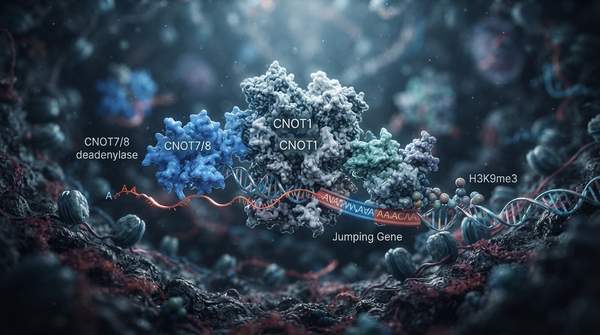
Microscopic view of RNA and protein systems, some thriving and others fading, representing the delicate balance of early life and extinction risks.

Researchers at the University of Tokyo have precisely mapped the environmental tipping points that determine if a self-replicating RNA-protein system will flourish into complexity or vanish entirely. This work offers a fresh perspective on how early life, built on RNA and protein interactions, navigated its surroundings, potentially reshaping discussions about life's very beginnings.

Self-replicating systems appear inherently robust, yet their survival and evolution hinge on specific, often fragile, environmental interactions. Persistence is not an internal guarantee; external conditions dictate their long-term fate.

Understanding these precise environmental dependencies is crucial for unraveling the origins of life and for engineering stable synthetic biological systems.

The Delicate Dance of Self-Replication

The University of Tokyo team observed how self-replicating systems interact with their surroundings, either maintaining or losing functional integrity. This interaction, the research reveals, dictates the long-term viability of these processes. Functional integrity is never a given; it is a dynamic state, constantly challenged by environmental interactions. This directly links external stability to the system's very existence.

Mapping the Tipping Points of Life and Extinction

Scientists precisely mapped the conditions where these self-replicating systems either sustain their cycles or collapse entirely. The University of Tokyo's research reveals specific, critical thresholds. Crossing these determines the system's fate. This precise mapping shows the line between a thriving, complex biological system and utter collapse is astonishingly thin. Even minor planetary shifts, therefore, could have profound, non-linear impacts on nascent life, challenging the very notion of gradual evolution.

Implications for Life's Origins and Synthetic Biology

The University of Tokyo's findings clarify the relationship between environmental variables and the stability of self-replicating molecules. This clarity is vital for theoretical models of abiogenesis and aids practical applications in designing synthetic biological systems.

The research demands a re-evaluation of 'survival of the fittest' for early life. It suggests success was less about internal fitness and more about external environmental alignment. The very idea of 'stability' for self-replicating molecules is a misnomer; their existence is a continuous, fragile negotiation with their surroundings, making them highly susceptible to environmental perturbations. This shifts how scientists view early evolutionary pressures and highlights the constant interaction needed for survival.

The Road Ahead for Self-Replicating Research

Future work will focus on experimentally validating these mapped conditions through detailed laboratory experiments. Researchers will explore their implications for astrobiology and drug discovery, refining models of life's emergence on other planets. By 2026, new synthetic biological systems could incorporate these stability insights, confirming how specific temperature or chemical shifts impact replication.

Your Questions About Self-Replication Answered

What are RNA-protein self-replication systems?

These systems involve RNA as genetic material and enzymes, with proteins offering structural or catalytic support. They form a basic partnership, each component assisting the other's replication. This cooperative cycle, integrating protein functions, is considered a potential precursor to cellular life, distinct from simpler RNA-only replicators.

How might specific environmental factors influence these systems?

Factors like pH levels, temperature fluctuations, or specific metal ions critically affect RNA-protein self-replication. Extreme acidity or alkalinity, for example, might denature proteins, halting replication. Conversely, certain mineral surfaces could stabilize the system, scaffolding efficient copying.

What role do these systems play in astrobiology?

In astrobiology, these systems model how life might originate and persist on other planets. Studying their environmental dependencies helps identify potential habitable zones beyond Earth. Understanding these fragile systems guides the search for biosignatures, focusing on conditions that could support such early, complex chemistries.