Inherited retinal diseases are being attacked with two fundamentally different genetic strategies—replacing a broken gene or editing it in place—and two different ways of getting the therapy into the eye. The field's one approved product, Luxturna, uses gene replacement delivered by subretinal injection for a specific form of Leber congenital amaurosis. Behind it sits a pipeline of experimental therapies for achromatopsia and X-linked retinitis pigmentosa that shows both how promising and how fragile this field can be.
Understanding Inherited Retinal Diseases and Gene Therapy
Inherited retinal diseases are a group of genetic conditions in which mutations gradually destroy the retina's light-sensing cells, often leading to severe vision loss. The primary targets of gene therapy are the outer retinal cells: the photoreceptors and the retinal pigment epithelium (RPE), the supporting layer beneath them. Because these diseases arise from specific gene defects, most gene therapies are designed to address one particular condition and would be ineffective for others, as Drug Discovery World's Diana Turner explains in a 2025 overview of the field.
That specificity is both the strength and the constraint of the approach. A therapy built around one mutated gene cannot simply be repurposed for a different disease, even when the symptoms look similar. The choice of strategy, Turner writes, usually comes down to the nature of the disease, the affected gene or genes, and what existing treatment options can offer.
Gene Therapy Strategies: Replacement vs. Editing
Gene replacement is what most people picture when they hear "gene therapy": a new, correct copy of a gene is delivered into cells to compensate for one that is missing or mutated. This approach works best for loss-of-function mutations in recessive or X-linked disorders, where the problem is a gene that fails to produce a functional protein. It dominates the field—of all inherited retinal disease gene therapies tested in the United States, nearly 70 percent involve gene replacement, according to Turner's reporting.
The flagship example is Luxturna, an AAV vector approved by the FDA in 2017 for Leber congenital amaurosis in people with biallelic RPE65 mutations. Gene editing takes a different path: rather than adding a working copy, tools such as CRISPR-Cas9 directly modify the existing DNA. A review of studies from 2020 to 2025 notes that CRISPR/Cas9 genome editing reduced photoreceptor degeneration in an X-linked retinitis pigmentosa model, and that dominant diseases with gain-of-function mutations require approaches like gene suppression, antisense oligonucleotides, or genome editing rather than simple replacement.
Comparing Retinal Gene Therapy Delivery Methods
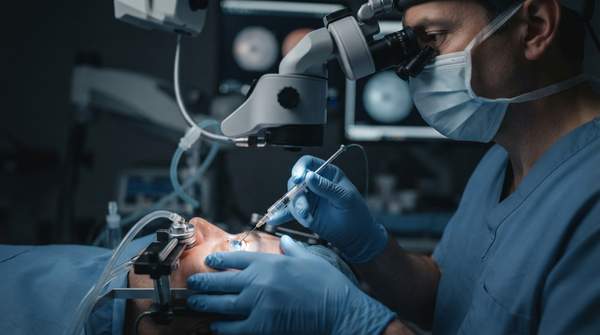
Getting the therapy to the right cells is its own engineering problem, and the field has settled on two main answers. Subretinal injection delivers the vector directly into the space between the RPE and the neurosensory retina, giving the therapy immediate access to the photoreceptors and RPE cells that most inherited retinal diseases affect. Intravitreal injection places the therapy into the vitreous, the gel that fills the eye, in a less invasive procedure that aims for wider distribution across the retina.
| Delivery Method | Procedure | Target Cells | Key Advantage or Challenge | Example |
|---|---|---|---|---|
| Subretinal injection | Surgical delivery into the space between the RPE and neurosensory retina | Photoreceptors and RPE cells | Precise targeting of outer retinal cells and effective across retinal layers, but technically demanding surgery with risks including retinal damage | Luxturna for RPE65-related Leber congenital amaurosis |
| Intravitreal injection | Injection into the vitreous humor of the eye | Aims for wider distribution across the retina | Less invasive than subretinal delivery, but distribution can be limited by vitreous barriers and targeting of the outer retina is less precise | 4D-110, an intravitreal delivery of REP1 in a phase 1 dose-escalation study |
The trade-off is visible in practice. A University of Oxford trial delivering REP1 subretinally revealed surgical complications including foveal damage, which prompted the use of an automated injection system, intraoperative OCT, and a subretinal saline pre-bleb technique to limit retinal stretch and reflux into the vitreous, according to a 2024 pipeline review in Retina Today. To decrease the risk of retinal damage from surgery itself, 4D Molecular Therapeutics is exploring intravitreal delivery of the same gene using the same AAV capsid technology it employs for RPGR.
Gene Therapy Progress for Leber Congenital Amaurosis (LCA)
LCA is the field's founding success. The identification of the RPE65 gene in autosomal recessive LCA type 2, back in 1993, opened the door to targeted genetic treatment, and LCA2 has since been frequently used as a model disease for testing prospective therapies, as a European Society of Medicine review notes. Luxturna's 2017 FDA approval for biallelic RPE65 mutations turned that research into the first approved gene therapy for an inherited retinal disease.
The approval also established the template the rest of the field follows: an AAV vector carrying a replacement gene, delivered subretinally to patients whose disease stems from a specific, testable mutation. It remains the benchmark against which newer programs measure themselves, even as researchers work to extend the approach to genes too large for AAV vectors and to mutation patterns that replacement alone cannot fix.
Gene Therapy Progress for Achromatopsia
Achromatopsia shows how uneven progress can be even within a single disease. It is an autosomal recessive condition in which an estimated 70 to 80 percent of cases are associated with mutations in CNGA3 or CNGB3, genes encoding subunits of the cone cyclic nucleotide-gated channels. Gene replacement trials have targeted both, with sharply different outcomes.
Three-year outcomes from the STZ Eyetrial of CNGA3 gene replacement reported no serious adverse events, though no statistical significance was reached between treated and untreated eyes, because improvements were also observed in the untreated eye. A separate phase 1/2 trial of AGTC-402 for CNGA3 was halted due to lack of consistent biological improvement and three cases of severe inflammation. The phase 1/2 trial targeting CNGB3 showed promising results, but that program stopped because of a sponsorship change. The setbacks are real, but so is the lesson: the delivery method and the mutation both matter, and neither guarantees success on its own.
Navigating the Future of IRD Gene Therapies
Patients and clinicians should monitor the progress of gene therapies in advanced clinical trials for specific inherited retinal diseases, weighing both the therapeutic approach—replacement versus editing—and the delivery method, since the achromatopsia experience shows that a sound strategy can still stumble on biology or inflammation. The clearest signals to watch are regulatory approvals for new gene therapies, positive topline data from pivotal trials, and expanded indications for existing treatments. Each of those milestones would mark the field moving beyond its single approved therapy toward the broader set of conditions it aims to reach.
Sources
- Gene therapy for inherited retinal diseases - PMC
- Gene therapies for inherited retinal disorders - Drug Discovery World (DDW)
- Gene Editing in Hereditary Retinal Disease Treatment - European Society of Medicine — European Society of Medicine -
- Retinatoday
- Progress in treating inherited retinal diseases — PMC