CRISPR is famous for editing genes, but some of its most practical power lies in a different trick: finding one specific genetic sequence in a sample and, upon finding it, triggering a frenzy of molecular cutting that produces a readable signal. That is the essence of CRISPR-based diagnostics. Two platforms anchor the field — SHERLOCK, built on the RNA-targeting enzyme Cas13, and DETECTR, built on the DNA-targeting enzyme Cas12. Both exploit a behavior called trans-cleavage, or collateral cleavage, in which a Cas enzyme that has found its target switches into a non-specific cutting mode and shreds nearby reporter molecules. This article traces that mechanism step by step, compares the two platforms, and surveys where the technology has been demonstrated.
Beyond Gene Editing: CRISPR's Role in Diagnostics
The same programmability that makes CRISPR useful for genome engineering also makes it a natural detector. A Cas enzyme paired with a guide RNA can be directed to any complementary nucleic acid sequence — a fragment of a virus, a cancer-associated mutation, or any other genetic signature of interest. As one review of the field puts it, the discovery of CRISPR and CRISPR-associated proteins "revolutionized genome editing and concurrently enabled a new generation of molecular diagnostic tools."
The diagnostic branch of the field came into public view during the COVID-19 pandemic. As Synthego's guide to the technology recounts, CRISPR-based systems "rapidly emerged as powerful tools for molecular diagnostics" during that period, with early applications demonstrating how programmable nucleic acid detection could complement traditional testing. SHERLOCK and DETECTR enabled rapid detection of SARS-CoV-2 in both laboratory and near-patient settings, helping establish the foundation for a broader class of CRISPR-enabled diagnostics.
What distinguishes these tools from ordinary probe-based tests is the amplification built into the enzyme itself. The Cas protein does not merely bind its target and report back; binding flips a molecular switch that converts one recognition event into many cutting events. Understanding that switch is the key to understanding the whole field.
The Molecular Mechanism: How CRISPR-Cas Detects and Signals
The mechanism rests on a counterintuitive fact: Cas12 and Cas13, the enzymes at the heart of the leading diagnostic platforms, are sloppy cutters — but only after they have been precise finders. Each enzyme carries a CRISPR RNA (crRNA) that serves as its address label. The crRNA-Cas complex scans the sample for a stretch of nucleic acid complementary to that guide sequence, and this binding is highly specific to the target.
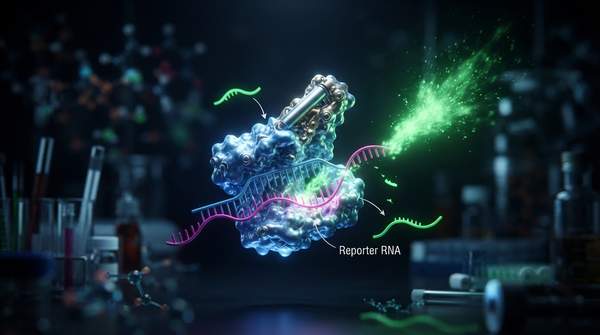
Once the enzyme locks onto a true target, it undergoes a conformational change that activates a second, non-specific nuclease function. The enzyme then begins cleaving any single-stranded nucleic acid in its vicinity — not just the target it was designed to find. This collateral activity is the critical switch from specific recognition to indiscriminate cleavage, and it is what turns a single binding event into an amplified signal.
Diagnostics exploit this by deliberately supplying the enzyme with reporter molecules: short single-stranded nucleic acids tagged with a fluorophore at one end and a quencher at the other. While intact, the quencher suppresses the fluorophore and the reporter stays dark. When an activated Cas enzyme cuts the reporter, the fluorophore separates from the quencher and emits light. Because one activated enzyme can cut many reporters, the signal accumulates rapidly and can be read visually or with instrumentation.
The CRISPR Diagnostic Mechanism: A Step-by-Step Explainer
The sequence below traces the full path from a target molecule in a sample to a positive result, showing the distinct roles of the guide RNA, the Cas enzyme, and the reporter molecules.
- Target recognition. A Cas enzyme guided by its crRNA identifies and binds a complementary target nucleic acid sequence. This binding is highly specific to the intended target.
- Enzyme activation. Target binding triggers a conformational change in the Cas enzyme, switching on its non-specific nuclease activity — the pivotal transition from precise finder to indiscriminate cutter.
- Collateral trans-cleavage. The activated enzyme cleaves nearby single-stranded nucleic acid reporters regardless of their sequence. This collateral cleavage is the amplification step: one recognition event yields many cuts.
- Signal generation. Each cut reporter — typically a fluorophore-quencher pair — releases its fluorophore from its quencher, producing fluorescence that accumulates as more reporters are cleaved.
- Readout. The resulting signal is interpreted visually or with instrumentation as a positive or negative diagnostic result.
The elegance of the design is that specificity and amplification are handled by the same molecular event. The guide RNA decides what is detected; the enzyme's collateral activity decides how loudly it is announced.
SHERLOCK vs. DETECTR: Key Differences in Diagnostic Platforms
The two flagship platforms apply the same logic to different kinds of genetic material, and their names encode the distinction. SHERLOCK — formally, Specific High-sensitivity Enzymatic Reporter unLOCKing — primarily utilizes Cas13 enzymes, which are adapted for RNA detection. Cas13 is activated by binding to specific RNA targets, which leads to non-specific RNase activity against surrounding reporters. DETECTR — DNA Endonuclease-Targeted CRISPR Trans Reporter — primarily utilizes Cas12, which is adapted for DNA detection; Cas12 activation by a specific DNA target leads to non-specific DNase activity.
| Platform | Core enzyme | Target nucleic acid | Collateral activity |
|---|---|---|---|
| SHERLOCK | Cas13 | RNA | Non-specific RNase cleavage of reporters |
| DETECTR | Cas12 | DNA | Non-specific DNase cleavage of reporters |
In practice, the choice of platform often follows the biology of the sample. RNA viruses and gene-expression signatures point toward a Cas13 system; DNA targets such as genomic mutations or DNA viruses point toward Cas12. Both platforms combine the same two ingredients — target recognition precision and a reporter system — to achieve what the literature describes as ultra-sensitive detection of pathogen-specific nucleic acids.
Real-World Impact: Applications of CRISPR-Based Diagnostics
The clearest demonstration to date has come in infectious disease. During the COVID-19 pandemic, SHERLOCK and DETECTR were both rapidly adapted to detect SARS-CoV-2, in laboratory settings and in near-patient contexts where fast, equipment-light answers matter most. That deployment established a template: once a pathogen's genetic sequence is known, a CRISPR diagnostic can in principle be programmed against it quickly.
Cancer detection is a second demonstrated frontier. In work covered by the American Association for Clinical Laboratory Science's publication, researchers reported finding cancer mutations in cell-free DNA from saliva samples. "All of these improvements now give us even more diagnostic information and put us closer to a tool that can be deployed in real-world applications," said senior author Zhang, a core institute member at the Broad Institute and investigator at the McGovern Institute for Brain Research at MIT. The significance of that result lies in the sample type: cell-free DNA in saliva is far easier to collect than tissue, and CRISPR's sensitivity makes mutation detection in such sparse material plausible.
More broadly, the same mechanism — programmable recognition of a nucleic acid signature followed by amplified reporting — is not limited to human medicine. Any context where a specific genetic sequence indicates a condition of interest, from pathogens in water to contaminants in food, is in principle addressable with the same tool kit, and the field's literature frames these platforms as a general class of detection technology rather than a single-purpose test.
The Future of CRISPR Diagnostics: Accessible and Versatile Detection
CRISPR-based diagnostics offer a versatile and highly sensitive approach for detecting nucleic acids, enabling rapid and accurate identification of pathogens, genetic mutations, and environmental contaminants. The mechanism that makes them work — a guide-directed search, an activation switch, and collateral cleavage of reporters — is shared across platforms, which means improvements in one system often translate to others. For readers tracking the field, the indicator to watch is continued expansion of CRISPR diagnostic platforms into new fields, evidenced by regulatory approvals for point-of-care tests and increased adoption in diverse settings like agriculture and food safety. Each new approval or deployment would mark the same milestone: the trans-cleavage mechanism moving from a laboratory demonstration to a tool someone outside a specialist lab can act on.