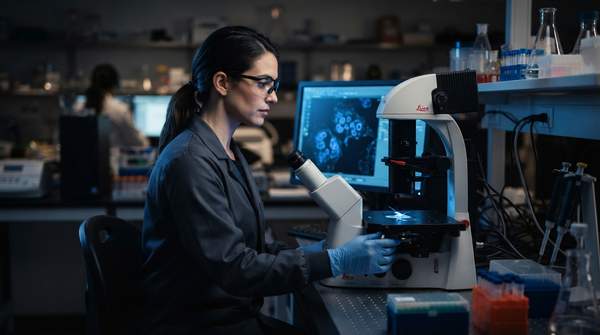
Originally recognized for its revolutionary capabilities in gene editing, CRISPR (Clustered Regularly Interspaced Short Palindromic Repeats) technology has rapidly evolved, demonstrating a broad range of applications that extend far beyond altering DNA sequences. This versatile technology now plays a significant role in areas such as disease diagnostics, the precise control of gene expression without changing underlying DNA, and various other biotechnological advancements. The potential of CRISPR technology is far from reaching its limits, as researchers continue to explore how different CRISPR-associated (Cas) enzymes can be harnessed to detect specific nucleic acid sequences, modulate epigenetic markers, and even visualize genetic material within living cells. This rapid expansion highlights the technology's immense potential across scientific and medical fields, as detailed in a review published by Mary Ann Liebert, Inc., publishers.
CRISPR in Diagnostics: Rapid and Specific Detection
CRISPR-based technologies have emerged as powerful tools for disease diagnostics, offering rapid and accurate detection of specific nucleic acid sequences associated with various conditions. These diagnostic platforms leverage the highly specific target recognition activity of CRISPR-associated nucleases, such as Cas12 and Cas13, to identify DNA or RNA sequences with exceptional sensitivity and programmability. The core principle often involves a guide RNA that directs a Cas enzyme to a complementary target sequence. Upon successful binding to the target, some Cas enzymes undergo a conformational change that activates a non-specific "collateral cleavage" activity.
This means they begin to cut not only the intended target but also nearby non-specific reporter molecules, which are typically labeled with a fluorescent or colorimetric tag. The cleavage of these reporters generates a detectable signal, indicating the presence of the target nucleic acid. This approach has expanded beyond infectious disease detection to include genetic disease screening and precision molecular diagnostics, as noted by Synthego.
Comparing Key CRISPR-Based Diagnostic Platforms
| Diagnostic Platform/System | Key Cas Enzyme | Mechanism/Principle | Key Advantage(s) |
|---|---|---|---|
| SHERLOCK (Specific High-sensitivity Enzymatic Reporter UnLOCKing) | Cas13 enzymes | Detects specific RNA sequences. Upon target RNA binding, Cas13 activates collateral cleavage of nearby reporter molecules, leading to a detectable signal. | Offers high sensitivity, specificity, and rapid detection for various targets, including viral infections and genetic mutations. |
| DETECTR (DNA Endonuclease-Targeted CRISPR Trans Reporter) | Cas12 enzymes | Detects specific DNA sequences. Upon target DNA binding, Cas12 activates collateral cleavage of nearby reporter molecules, generating a measurable signal. | Provides high sensitivity, specificity, and rapid detection for various targets, such as viral infections and genetic mutations. |
| STOPCovid | Cas12 enzymes | A Cas12-based approach designed for rapid viral detection. It leverages the DNA-targeting capabilities of Cas12 for simplified, rapid readouts. | Focuses on simplified, rapid readouts suitable for scalable testing workflows, expanding to genetic disease detection and molecular screening. |
Platforms like SHERLOCK (Specific High-sensitivity Enzymatic Reporter UnLOCKing) utilize Cas13 enzymes, which are RNA-targeting. When a guide RNA directs Cas13 to a specific RNA sequence, the enzyme binds and activates its collateral cleavage activity, cutting nearby reporter molecules and producing a detectable signal. This system offers high sensitivity, specificity, and rapid detection for various targets, including viral infections and genetic mutations, according to a review in PMC. Similarly, DETECTR (DNA Endonuclease-Targeted CRISPR Trans Reporter) employs Cas12 enzymes, which are DNA-targeting. Upon target DNA recognition, Cas12 also exhibits collateral activity, cleaving reporter molecules to generate a measurable signal. This provides high sensitivity, specificity, and rapid detection for targets like viral infections and genetic mutations.
Another Cas12-based system, STOPCovid, was developed for rapid viral detection, emphasizing simplified and quick readouts suitable for scalable testing workflows. While initially accelerated by the urgent need for viral detection, CRISPR diagnostics have since expanded far beyond infectious diseases, now being extended into broader applications such as genetic disease detection and precision molecular screening. These systems collectively highlight how CRISPR's precise targeting capabilities can be adapted for highly sensitive and specific diagnostic applications, offering significant advancements in disease detection.