The humanoid robot market could reach $38 billion within the next decade, according to Goldman Sachs. The $38 billion projection confirms a significant commercial shift toward embodied AI robotics. Industrial applications drive development, as companies anticipate widespread adoption by 2026. Such rapid growth will redefine industrial labor roles, impacting sectors from manufacturing to logistics.
Technical capabilities in embodied AI and robotics are advancing at an unprecedented pace, yet broader industrial adoption and societal integration remain in their nascent stages. This creates a fundamental tension between the rapid evolution of technology and the practical challenges of deploying it at scale across diverse industries.
Companies must urgently integrate these technologies. Failure means being outpaced by competitors leveraging new efficiencies. Businesses also face navigating the ethical, economic, and labor implications of a workforce increasingly reliant on advanced humanoid development. This article explores these transformative forces and their impending impact.
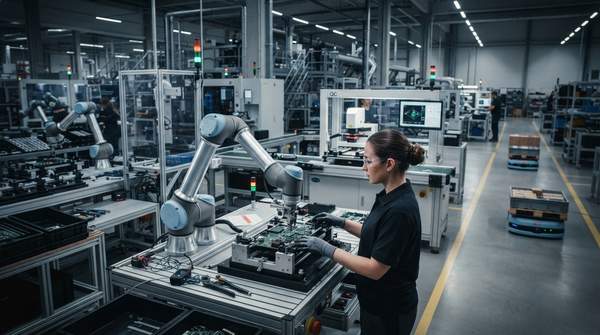
Advanced AI integration into robotic systems will disrupt traditional industrial operations. Humanoid robots are moving beyond conceptual designs, preparing for roles demanding human-like dexterity and real-time decision-making. This forces industries to fundamentally reconsider workflows, supply chains, and workforce planning. The shift will redefine human responsibilities, requiring new skills and adaptation. It moves beyond simple task augmentation, extending to how human-robot collaboration will function in industrial settings by 2026.
The Multi-Billion Dollar Horizon for Humanoid Robotics
- $38 billion — The humanoid robot market could reach this value within the next decade, according to Goldman Sachs. This forecast confirms a significant anticipated expansion, fueled by industrial demand.
- $66 billion — Fortune Business Insights estimates the humanoid robot market will grow to this figure by 2032, as reported by Forbes. This higher projection suggests greater optimism for market penetration and technological maturity.
- $50,000 — This is the approximate unit cost for a humanoid robot, according to Forbes. This price point implies industries anticipate substantial long-term returns and operational efficiencies.
Market projections, from $38 billion to $66 billion, confirm explosive growth for humanoid robotics. Uncertainty remains regarding exact scale and speed of adoption. Such forecasts, coupled with the $50,000 unit cost, indicate industries are not merely augmenting tasks. They are actively preparing for a labor paradigm where human-like robots fill critical roles. This preparation demands complex cost-benefit analyses, factoring in long-term operational savings and productivity gains that outweigh initial capital outlay.
A Surge of Innovation: Industry Showcases and New Capabilities
CVPR 2026 will feature over 100 exhibitors showcasing embodied AI, robotics, autonomous vehicles, computer vision, and agentic AI technologies, according to Robotics & Automation News. The presence of over 100 exhibitors confirms a rapidly maturing market for AI-driven solutions, showing broad engagement from developers and manufacturers. Nvidia will showcase its Nemotron 3 Nano Omni model, a multimodal AI agent development technology to enhance robot intelligence. Ultralytics plans to showcase Yolo26, a lightweight real-time vision AI model for edge devices and large-scale industrial deployments.
The simultaneous emergence of industry-wide events with over 100 exhibitors and specialized AI models like Nemotron 3 Nano Omni and Yolo26 confirms a rapidly maturing technological ecosystem. This ecosystem is poised for practical application across industrial sectors, from manufacturing floors to logistics warehouses. The focus on edge-optimized AI vision models drives pervasive, intelligent automation. This enables deployment even in environments with limited on-site computing resources. This development challenges traditional heavy infrastructure, lowering the barrier to entry for widespread AI integration.
The Technical Engine: How AI and Accelerated Computing Power Robotics
AI-driven robots now use simulation-based learning to adapt to dynamic environments, refining navigation and manipulation, according to NVIDIA. This approach allows robots to learn from vast virtual data sets, accelerating development cycles. They perform complex tasks previously unfeasible, moving beyond rigid, pre-programmed automation. The NVIDIA nvblox CUDA-accelerated library further enhances this. It enables robots to identify obstacles in 3D spaces up to five meters away and generate a 2D costmap, as detailed on the NVIDIA Developer Blog. This capability is critical for safe, efficient operation in crowded industrial settings.
NVIDIA nvblox achieves 3D reconstruction 100 times faster than CPU-centric methods. Extreme performance gains in AI perception rapidly close the capability gap, making the $50,000 humanoid robot cost increasingly justifiable for industrial deployment. This speed allows robots to process environmental data in real-time, react instantly, and maintain continuous awareness. Breakthroughs in simulation, real-time 3D perception, and accelerated computing fundamentally transform robot autonomy and operational efficiency, setting new benchmarks for intelligent automation.
The Next Generation of Industrial Automation
Precision navigation will redefine robotic autonomy in industrial settings.
- NVIDIA cuVSLAM achieves sub-1% trajectory errors for real-time, CUDA-accelerated visual SLAM, according to the NVIDIA Developer Blog. This accuracy is crucial for demanding industrial applications.
Precision in simultaneous localization and mapping (SLAM) allows robots unprecedented accuracy in complex, dynamic industrial environments. It minimizes operational errors. Such low error rates make robots reliable for tasks requiring fine motor control and consistent path execution, directly impacting product quality and operational safety. This capability is essential for wider adoption in manufacturing and logistics. Minor deviations lead to significant inefficiencies, costly reworks, or safety hazards. Precision, coupled with AI advancements, points to a new era: robots are not just fast, but highly accurate and adaptable. This enables more sophisticated, flexible industrial automation.
If companies fail to strategically integrate these advanced, cost-justified humanoid robotics and AI vision systems, they will likely face significant competitive disadvantages in the rapidly evolving industrial landscape by 2026.