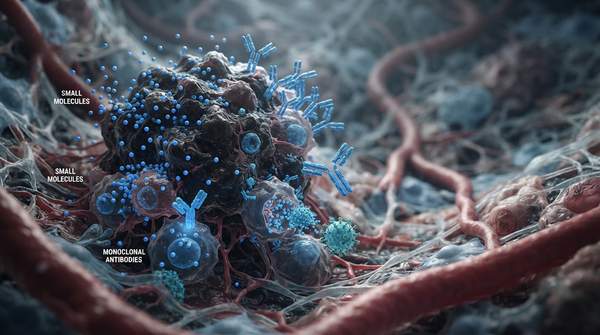
Targeted cancer therapies differ from traditional chemotherapy in one fundamental way: they aim at specific molecules that drive cancer growth rather than broadly attacking fast-dividing cells. But "targeted therapy" is not one thing. Small-molecule inhibitors, monoclonal antibodies, antibody-drug conjugates, and oncolytic viruses work through distinct mechanisms, and the physical size of each drug largely determines where it can act — inside the cell or only on its surface. Understanding that distinction is the key to following modern oncology.
Small-Molecule Inhibitors: Targeting Within the Cell
Small-molecule inhibitors are lab-made chemicals small enough to slip through the cell membrane. Once inside a cancer cell, they block a specific biomarker or substance, preventing the cell from growing and spreading, as the American Cancer Society explains. Their generic names typically end in "-ib," such as imatinib.
A review for primary care physicians notes that these drugs owe their intracellular reach to their low molecular weight, letting them pass through the cell surface to reach targets inside and slow proliferation or trigger tumor cell death. Many are kinase or protease inhibitors, and their names often end in "-nib" or "-mib" — examples include bortezomib, osimertinib, and vemurafenib.
The practical consequence is straightforward: when the cancer's driver is an intracellular signaling protein, a small molecule is often the right tool. A review of molecular targeted therapy notes that small-molecule agents acting as signal transduction inhibitors have become a backbone of precision cancer medicine and are now used as first-line therapy for various human cancers, with efficient anticancer effects and fewer side effects than conventional chemotherapy.
Monoclonal Antibodies: Surface-Level Precision
Monoclonal antibodies are lab-made proteins engineered to bind specific antigens with high specificity and affinity. Their defining limitation is size: they are too big to enter a cancer cell directly. Instead, they act on the cell surface or in the surrounding environment, blocking a specific target from the outside.
That constraint comes with advantages. A review in Signal Transduction and Targeted Therapy highlights several: because monoclonal antibodies are so specific in their mode of action, they pose a lower risk of side effects on healthy cells, they can act quickly, and several of them also work as immune modifiers that sustain long-term immune activity against the tumor.
Recognizing them is easy once you know the convention: their names typically end in "-mab." Familiar examples include rituximab, bevacizumab, trastuzumab, pertuzumab, and panitumumab.
Antibody-Drug Conjugates: Targeted Drug Delivery
Antibody-drug conjugates (ADCs) combine the two approaches above. They pair the targeting specificity of a monoclonal antibody with a potent cytotoxic drug payload. The antibody seeks out a specific antigen on the cancer cell surface and delivers the drug directly to cells expressing that antigen, and the drug is released after the conjugate is internalized into the cell.
This design turns the antibody's size from a limitation into a delivery mechanism. Because the antibody component ensures the toxic payload reaches cancer cells rather than circulating freely, ADCs aim to concentrate cell-killing chemistry where it is needed. Brentuximab vedotin, used in treating Hodgkin lymphoma and some other lymphomas, is one example of a monoclonal antibody-drug conjugate.
Oncolytic Viruses: Harnessing Viral Power
Oncolytic viruses take a fundamentally different approach. Rather than blocking a single molecule, they are viruses engineered to infect and destroy cancer cells directly while stimulating the body's own immune response against the tumor. Their mechanism is therefore dual: direct destruction of cancer cells and activation of anti-tumor immunity.
This makes oncolytic viruses a distinct branch of targeted therapy — one that works through replication and immune activation rather than biochemical inhibition. They are discussed here as a fourth category of mechanism, though their target-location profile differs enough from the drug classes above that they sit outside the direct comparison framework below.
Comparative Overview of Targeted Cancer Therapies
The table below contrasts the three drug classes across the dimensions that matter most: how they act, where their target sits, and what strategy they embody. The organizing logic is physical: small molecules penetrate cells; antibodies cannot, so they act outside; ADCs use an antibody to ferry a payload inside.
| Therapy Type | Mechanism of Action | Molecular Target Location | Examples |
|---|---|---|---|
| Small-molecule inhibitors | Block specific proteins driving growth and division inside the cell | Intracellular (inside the cell) | Bortezomib, osimertinib, vemurafenib, imatinib |
| Monoclonal antibodies | Bind specific antigens on the cell surface or in the surrounding environment | Extracellular (cell surface) | Rituximab, bevacizumab, trastuzumab, pertuzumab, panitumumab |
| Antibody-drug conjugates | Antibody delivers a cytotoxic payload to cells expressing a specific antigen; drug released after internalization | Surface antigen, payload acts inside the cell | Brentuximab vedotin (Hodgkin lymphoma) |
Read the table as a decision framework: if the target is inside the cell, a small molecule is required; if the target is a surface protein, an antibody can reach it; if the goal is delivering a toxic payload selectively, an ADC merges both capabilities.
The Challenge of Drug Resistance
Precision does not guarantee permanence. A review of molecular targeted therapy identifies poor efficacy, toxicity, and tumor relapse due to drug resistance as major obstacles for targeted therapy-based anticancer treatment, calling for further investigation into personalized therapies that overcome resistance while reducing side effects.
Researchers echo that urgency. A Frontiers review by Hou and colleagues notes that molecular targeted therapies are widely applied clinically, but drug resistance largely limits their clinical benefits, and that understanding the underlying resistance mechanisms is critically important. Their proposed path forward combines patient-derived models with CRISPR-Cas9 gene-editing screens to decipher resistance mechanisms and identify new therapeutic targets.
For patients and families, the takeaway is that targeted therapies can lose effectiveness over time — not because the drugs stop working randomly, but because cancer cells evolve. This is why combination strategies and next-generation inhibitors remain active research frontiers.
Personalizing Cancer Treatment: The Future of Targeted Therapies
Why does this taxonomy matter? Because matching the drug to the target is the essence of personalized oncology. A tumor driven by an intracellular kinase mutation calls for a small-molecule inhibitor; a tumor driven by an overactive surface receptor calls for an antibody; a tumor bearing a well-defined surface antigen may be a candidate for an ADC. The physical properties of each drug class dictate which targets are reachable.
Readers can now distinguish between major types of targeted cancer therapies and understand why their distinct mechanisms and target locations make them suitable for different therapeutic strategies. The measurable indicator of progress in this field is the continued development and FDA approval of new targeted therapies with novel mechanisms or improved specificity — a trend worth watching as resistance research matures. This article explains mechanisms only; it is not medical advice, and treatment decisions belong with an oncologist.
Sources
- How Does Targeted Therapy Work? — CANCER
- Targeted cancer therapies: Clinical pearls for primary care - PMC
- Molecular targeted therapy for anticancer treatment - PMC
- Exploring treatment options in cancer: tumor treatment strategies - Signal Transduction and Targeted Therapy — Nature
- Frontiers | Evolution of Molecular Targeted Cancer Therapy: Mechanisms of Drug Resistance…