Earth is the odd one out. Among the worlds we can study closely, ours is the only rocky planet whose crust is broken into mobile plates that slide, collide and recycle themselves into the mantle. Mars and Venus each wear a single, unbroken shell, but they behave very differently: Mars cooled early and now mainly rips along great rift valleys, while Venus is resurfaced by rising blobs of hot mantle that pucker and burst through its crust. Farther out, small icy moons such as Enceladus ignore the rule that small bodies are geologically dead, because tidal flexing supplies them with heat that has nothing to do with their size. Understanding which of these three systems a body follows comes down to two questions: where does its heat come from, and can its outer shell break into moving pieces?
Earth's Dynamic Plate Tectonics: A Baseline
To see what the other planets are missing, start with the machinery Earth runs on. The Lunar and Planetary Institute's overview of tectonism traces the whole story to a single word: heat. All the terrestrial planets began molten, or nearly so, and have been cooling ever since. As they cooled, each grew a strong outer layer — the lithosphere — while hot material kept moving in the interior, deforming the surface above. Large planets such as Venus, Earth and Mars are big enough to have stayed hot inside and to still show active tectonism.
What makes Earth distinctive is what its lithosphere does with that heat. Instead of one continuous shell, Earth's outer layer is divided into distinct, mobile plates that are recycled into the mantle and show large-scale lateral movements, as planetary geologists James Head and Sean Solomon described in a NASA-sponsored comparison of the terrestrial planets. Where plates collide, they raise mountain chains like the Rockies and Himalayas and feed volcanic arcs such as the Pacific's Ring of Fire. Where they slide past each other, as along California's San Andreas Fault, they produce severe earthquakes rather than volcanoes. The key consequence is continuous renewal: old crust is destroyed and new crust is created, so Earth's surface is constantly rewritten.
Single-Plate Worlds: Mars and Venus
Not having plate tectonics does not mean having no tectonics. Both Mars and Venus are single-plate planets — one spherical shell of lithosphere covering the whole body — yet their surfaces could hardly look more different. That contrast is the clearest lesson in comparative planetology: the same basic architecture, a rigid lid over a hot interior, can produce either a frozen, slowly cracking world or a violently resurfaced one, depending on how much heat the planet has retained and how its crust responds.
The difference tracks size and heat retention. As Head and Solomon noted, the Moon, Mars and Mercury have smaller volumes relative to their surface areas, so they cooled faster and grew thick lithospheres early, showing no evidence of the destruction and renewal of lithospheric plates over the latter 80 percent of their history. Venus, nearly Earth's twin in size, kept its heat and put it to very different use. The Planetary Society observes that Venus today appears to lack plate tectonics, yet it has clearly not been idle — which is exactly why planetary geologists rank understanding the Venus–Earth difference as a high priority.
Mars: A Stagnant Lid with Localized Rifting
Mars sits in the middle of the small-body spectrum. An educational treatment of planetary thermal evolution points out that Mars has a diameter about half that of Earth or Venus, but it is roughly half again larger than Mercury and about twice the size of the Moon. That intermediate size means it retained its internal heat longer than the Moon or Mercury and was more tectonically and volcanically active than either — but far less than Earth or Venus.
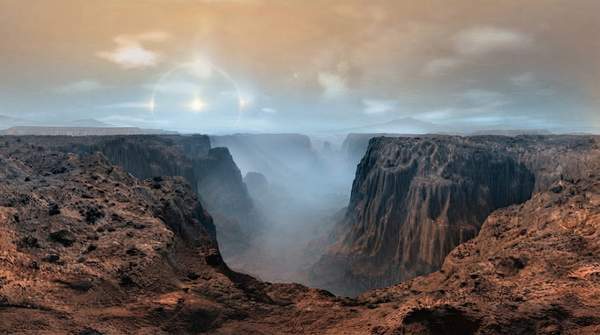
The result is what planetary scientists call a stagnant lid: a single, thick, immobile shell over a cooling interior. The tectonics that remain are mostly vertical and local. Mars shows evidence of rifting — great cracks where the crust has pulled apart, most dramatically in the Valles Marineris canyon system — but there is no lateral shuffling of plates, no subduction, no continental drift. Because nothing recycles the crust, ESA notes that four-billion-year-old rocks sit directly accessible to landers and rovers, a geological archive Earth's restless plates long ago destroyed. Mars has, in effect, stopped evolving: a world whose tectonic story was mostly written billions of years ago and has been slowly cooling ever since.
Venus: 'Blob Tectonics' and Global Resurfacing
Venus took the other path available to a single-plate world. With nearly Earth's size and internal heat, but no machinery for plates to slide and sink, Venus releases its energy in a different style that one planetary-evolution text calls "blob tectonics" — hot material from below puckers and bursts through the surface. Instead of long subduction zones, Venus builds circular coronae; instead of the linear volcano chains of plate boundaries, it forms flat-topped pancake volcanoes and other features born of hot material pushing up from beneath a lid that cannot move sideways.
The scale of this activity is striking. A comparative survey of planetary surfaces groups Venus with Earth, Io and Europa as bodies that have been completely resurfaced many times and retain no heavily cratered regions — the signature of the most sustained thermal evolution in the solar system. Mars, by contrast, has lost only about half of its ancient cratered terrain to tectonic processes, an intermediate status it shares with Ganymede and Enceladus. So Venus and Mars, both single-plate planets, bookend the range: one episodically repaved from below, the other a stagnant shell preserving most of its ancient face. Why a near-twin of Earth chose the blob route instead of plate tectonics remains one of the field's open questions.
Icy Moons: Tidal Heating and Cryovolcanism
The icy moons break the size rule entirely. For rocky planets, geological activity is basically a function of mass — bigger bodies stay hot longer, a relationship sometimes nicknamed the baked-potato effect. But as the planetary-evolution survey notes, bodies such as the active icy moons appear to have a size-independent source of energy: tidal heating. Instead of relying on leftover primordial heat trickling out of a cooling interior, these moons are squeezed and flexed by the gravitational pull of the giant planets they orbit, and that repeated flexing is converted directly into heat inside them.
The numbers are remarkable for such small worlds. A 2026 review of rocky planets as heat engines by Diogo Lourenço and colleagues, published in Space Science Reviews, identifies Io and Enceladus as the most prominent tidally heated bodies. Io, only slightly larger than Earth's Moon, has its rocky mantle heated by roughly 100 terawatts of tidal power — two orders of magnitude greater than the radiogenic heating it would receive from its own composition. Enceladus, a Saturnian moon just 500 kilometers across, is heated by 20 to 40 gigawatts and shows significant cryovolcanic activity near its south pole.
That activity produces features no rocky planet displays. Because the working material is ice rather than rock, tectonism on these moons builds ridges and fractures in frozen water and drives cryovolcanism — eruptions of volatiles from a warm interior through a cold icy shell. Europa, grouped with Venus and Earth among the most thoroughly resurfaced bodies, has had its ancient craters erased entirely. The lesson is that a moon a fraction of Earth's size, orbiting in the cold outer solar system, can be more geologically alive than a planet several times its mass, because its energy source is orbital rather than internal.
Comparative Tectonic Systems in Our Solar System
The table below categorizes each body by its primary heat source and lithospheric structure — the two factors that determine its tectonic style and how much its surface is renewed. Read it as a diagnostic: find the heat source and the shell structure, and the characteristic landforms follow.
| Celestial Body | Primary Heat Source | Tectonic Style | Key Geological Features | Crust Recycling |
|---|---|---|---|---|
| Earth | Internal heat driving mantle convection | Mobile plate tectonics; multiple plates with large-scale lateral movement | Mountain chains (Himalayas, Rockies), Ring of Fire volcanic arcs, transform faults like the San Andreas | Continuous; plates destroyed and renewed at boundaries |
| Mars | Residual internal heat, largely dissipated due to smaller size | Stagnant lid; single spherical shell with localized rifting | Great rift valleys such as Valles Marineris; ancient preserved crust | None; no plate destruction or renewal in the latter 80% of its history |
| Venus | Sustained internal heat, near-Earth in scale | Single-plate "blob tectonics"; hot mantle material rises and deforms the surface | Coronae, pancake volcanoes; surface completely resurfaced many times | Episodic resurfacing from below rather than plate recycling |
| Icy moons (e.g., Europa, Enceladus) | Tidal heating — size-independent, from gravitational flexing by the host planet | Tidally driven tectonics and cryovolcanism in an icy shell | Fractured icy terrain, erased craters on Europa, south-polar cryovolcanic activity on Enceladus (heated by 20–40 GW) | Extensive resurfacing; Europa fully resurfaced many times |
The comparison explains at a glance why Venus has coronae instead of subduction zones — its heat escapes by pushing up through a single lid, not by sinking plates — and why Mars has giant rift valleys but no continental drift: its shell is one piece, and it cracked rather than divided. The icy moons occupy a third column entirely, active not because they are big but because they are squeezed.
Understanding Planetary Tectonics: Key Takeaways
To understand a celestial body's geological activity, assess its primary heat source and the resulting lithospheric behavior. That two-step diagnostic sorts every world in this comparison: internal heat plus a broken shell gives Earth plate tectonics; internal heat plus a single shell gives Venus blob tectonics; fading internal heat in a small single-shell body gives Mars a stagnant lid with rifts; and tidal energy gives small icy moons an activity level their size alone would never permit.
The measurable indicator is written on each surface. The presence of specific surface features — rift valleys, coronae, cryovolcanoes — indicates the dominant tectonic style and underlying energy source. A heavily cratered, four-billion-year-old plain points to a stagnant lid; circular coronae and pancake volcanoes point to blob tectonics; fresh icy fractures and south-polar plumes point to tidal heating. For readers watching this field, the next milestones are observational: continued study of why Venus and Earth diverged, which the Planetary Society calls a high priority for planetary geologists, and closer scrutiny of tidally heated moons, where the Lourenço review's figures for Io and Enceladus give concrete benchmarks any future mission can test.
Sources
- Shaping the Planets: Tectonism — Lunar and Planetary Institute (LPI)
- Tectonic evolution of terrestrial planets - NASA Technical Reports Server (NTRS)
- Understanding why our most Earth-like neighbor, Venus, is so different — The Planetary Society
- OPEN
- ESA
- Explanet
- Rocky Planets as Heat Engines - Space Science Reviews — SpringerLink