Three emerging solar technologies—perovskite, organic, and quantum dot cells—are competing to challenge silicon's dominance, and each carries a distinct bargain. Perovskites deliver the highest reported efficiencies of the three but degrade under heat and humidity. Organic cells are cheap, light, and flexible, but trail on efficiency and durability. Quantum dot cells, particularly perovskite quantum dots, combine novel material properties with promising efficiency figures, yet remain the least mature of the three. Understanding these trade-offs matters more than any single headline number, because stability and scalability—not peak lab efficiency—will decide which technology reaches the market.
Perovskite Solar Cells: High Efficiency with Stability Hurdles
Perovskites have been the standout performer of the past decade of solar research. Through compositional alloying, post-processing refinements, interfacial engineering, and improved device architecture, researchers have pushed the power conversion efficiency of organic–inorganic hybrid perovskite solar cells above 25%, according to a review published in Nano-Micro Letters by a research team led by scientists at Pohang University of Science and Technology and Daegu Gyeongbuk Institute of Science and Technology. That figure represents high-performance laboratory results and approaches the efficiency of conventional silicon.
The material's appeal goes beyond raw performance. The U.S. Department of Energy notes that perovskites appear more resilient to imperfections in their crystal structure than other conventional semiconductors—a property known as defect tolerance that relaxes manufacturing precision. Industry analysis likewise points to abundant, low-cost source materials such as methylammonia, lead, and iodine, suggesting a favorable watts-per-dollar return. A broader review of photovoltaic materials adds that this scalability is vital for meeting growing renewable energy demand and positions perovskites as a key player in solar's future.
The catch is durability. Under operational circumstances—high temperature or humidity—hybrid perovskite absorbers decompose into lead iodide (PbI2), limiting long-term stability. The Department of Energy identifies cell stability and durability, efficiency at scale, manufacturability, and technology validation as the four primary challenges standing between perovskites and commercial success. The lead content also raises environmental questions that lifecycle analyses of the technology continue to examine.
Organic Solar Cells: Flexible and Cost-Effective, but Lower Efficiency
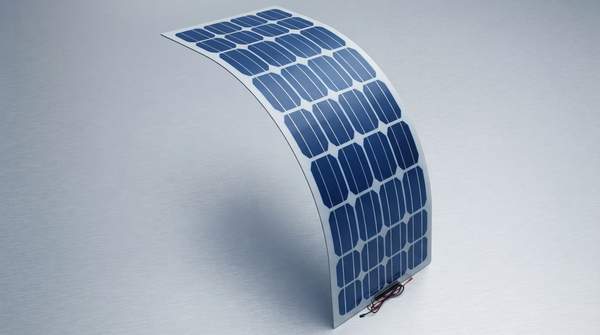
Organic solar cells take the opposite approach: they trade peak performance for versatility. As a thin-film technology, they use far less material than bulky silicon panels, absorb light strongly, cost less to produce, and bend—making them suitable for surfaces where rigid panels cannot go. Arizona State University's School for Engineering of Matter, Transport and Energy, which researches thin-film photovoltaics, notes that conventional silicon panels are heavy, material-intensive, and expensive to manufacture, while thin-film alternatives offer lower material usage, cost-effectiveness, and better flexibility.
That flexibility opens application space that silicon cannot easily reach, from curved surfaces to lightweight installations on structures that cannot bear conventional panel loads. A comparative review of photovoltaic cell materials groups organic cells among the technologies whose advantages, disadvantages, and efficiency ranges must be weighed against their environmental impact across the full lifecycle—manufacturing, energy efficiency, recycling potential, and sustainability.
But the same review and the thin-film research consensus agree on the limitation: improving the efficiency and durability of thin-film solar cells remains a challenge. The available comparative literature describes organic cells in terms of an efficiency range rather than a recent champion figure, and stability, manufacturing processes, and environmental impact are all flagged as ongoing concerns. In short, organic cells are the most application-flexible of the three but the least competitive on raw power output.
Quantum Dot Solar Cells: Promising Performance with Emerging Challenges
Quantum dot solar cells are the youngest of the three, and the strongest reported results come from a hybrid of the first two categories: perovskite quantum dots. A study published in the research literature on flexible photovoltaics reported a champion CsPbI3 quantum dot solar cell with an efficiency of 15.1%—a stabilized power output of 14.61%—described by its authors as among the highest reported to date. Building on the same hybrid interfacial architecture, the team achieved 12.3% efficiency on flexible substrates, a record for flexible quantum dot photovoltaics that significantly improved both efficiency and device reproducibility over control devices.
The reason these nanoscale materials punch above their weight is structural. The researchers found that perovskite quantum dot films have better mechanical stability and structural integrity than the equivalent bulk thin films. Related work by the Nano-Micro Letters team reinforces this: incorporating a dimensionally engineered star-shaped organic semiconductor (Star-TrCN) with CsPbI3 perovskite quantum dots passivated vacant sites and prevented moisture penetration, significantly improving the cubic-phase stability of the quantum dots.
Those advantages are specific to perovskite quantum dots, which combine properties of both material families. The technology's remaining hurdles are maturity-related: long-term stability, device reproducibility, and integration at practical areas must all be demonstrated before quantum dot cells can be assessed as true commercial contenders rather than promising laboratory devices.
Next-Generation Solar Cell Comparison
Setting the three technologies against consistent metrics makes the trade-offs visible. The table below juxtaposes reported efficiency, key advantages, and primary challenges drawn from the published research discussed above; use it to weigh each technology's current status against its development risks.
| Technology | Reported Efficiency | Key Advantages | Primary Challenges |
|---|---|---|---|
| Perovskite | Above 25% power conversion efficiency in high-performance laboratory hybrid cells | High efficiency; defect tolerance; abundant, low-cost materials; scalability potential | Degradation into PbI2 under high temperature or humidity; lead content; large-area coating and module integration |
| Organic | Described as an efficiency range; no precise recent champion figure in the comparative literature | Low material usage; cost-effectiveness; flexibility for thin-film applications | Lower efficiency; durability and stability concerns; manufacturing and environmental impact |
| Quantum dot | 15.1% champion CsPbI3 cell (14.61% stabilized); 12.3% on flexible substrates—among the highest reported to date | Better mechanical stability and structural integrity than bulk thin films (perovskite quantum dots); flexible-device capability | Development maturity: long-term stability, device reproducibility, and large-area integration still to be proven |
Read across the rows, the pattern is clear: perovskite's trade-off is efficiency versus stability, organic's is flexibility versus lower efficiency, and quantum dot's is novel material properties versus development maturity. No single column identifies a winner, because each technology's strength sits precisely where another's weakness begins.
Beyond Efficiency: The Critical Role of Stability and Scalability
Headline efficiency numbers are measured on small, carefully sealed laboratory cells, and they can mislead. A review of large-area perovskite manufacturing points out that materials sometimes behave differently at larger scales: a small cell can be hermetically sealed in a glovebox, but a meter-scale panel is far harder to encapsulate perfectly, and moisture or vapor intrusion at the edges can propagate and ruin an entire module. Edge sealing, encapsulation, and module integration are therefore engineering problems in their own right, distinct from the chemistry that produces champion efficiencies.
This is why the Department of Energy frames commercial success for perovskites around four challenges—stability and durability, efficiency at scale, manufacturability, and technology validation—rather than efficiency alone. The same logic applies across all three technologies. Organic cells must close the durability gap that limits their lifetime; quantum dot cells must demonstrate reproducibility and stability beyond record-setting single devices; and perovskites must survive real-world heat and humidity for years, not hours. Cost comparisons remain qualitative for now—researchers describe low-cost production potential for perovskites and cost-effectiveness for organic thin films, but published work reviewed here does not yet offer reliable cost-per-watt projections for pilot production.
Navigating the Future of Solar: Key Trade-offs for Commercial Viability
When evaluating next-generation solar technologies, prioritize long-term stability and manufacturing scalability alongside peak efficiency to assess true commercial potential. A cell that converts a quarter of sunlight in a glovebox is not yet a product; a flexible film that degrades in a few seasons is not yet a market. The evidence points to a concrete way to track progress: monitor advancements in material encapsulation techniques and successful pilot-scale production demonstrations for each technology. When a technology publishes sustained outdoor performance alongside a demonstrated large-area module—rather than another laboratory champion number—that will be the measurable signal it has begun to close its defining trade-off.
Sources
- Perovskite Solar Cells — Energy.gov
- The advantages of perovskite solar technology — Perovskite INFO
- Advancements in Photovoltaic Cell Materials: Silicon, Organic, and Perovskite Solar Cells - PMC
- Advancing solar cell technology through materials research - School for Engineering of Matter, Transport and Energy
- Flexible and efficient perovskite quantum dot solar cells via hybrid interfacial architecture - PMC
- High-Performance Perovskite Quantum Dot Solar Cells Enabled by Incorporation with Dimensionally Engineered… — SpringerLink
- MDPI