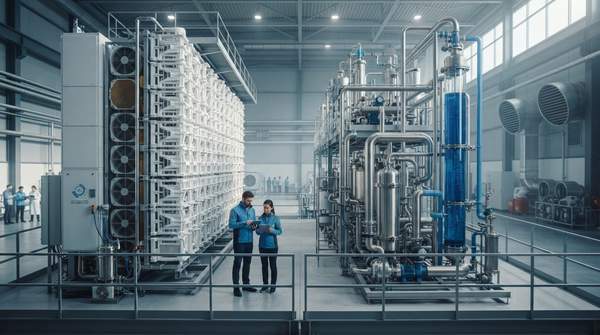
Direct air capture, the family of technologies that pull carbon dioxide straight out of ambient air, splits into two dominant engineering traditions: systems that trap CO₂ on solid sorbent materials, and systems that absorb it into liquid chemical solvents. Each works on a different principle, runs on a different mix of heat and electricity, and carries distinct implications for the land and water a project consumes. Understanding that split — and the newer hybrid and electrochemical approaches emerging around it — is the fastest way to make sense of the DAC projects now appearing in energy and climate policy debates.
Understanding Direct Air Capture: Two Main Approaches
The clearest way into the field is the distinction Mission Zero, a DAC developer, draws in its technical overview: most direct air capture technologies follow one of two high-level approaches, solid capture and liquid capture. In solid capture, an insoluble sorbent material adsorbs CO₂ from air, meaning the carbon particles stick to the material's surface rather than dissolving into it. The captured CO₂ is later released so the sorbent can be reused, and the regeneration step is where the engineering choices multiply — heat, reduced pressure, or a combination can do the work.
The U.S. Department of Energy's definition and company analysis report frames the landscape similarly, cataloguing companies by their capture medium type and, where applicable, by their regeneration method. Alongside the two mainstream categories, an industry analysis by Frost & Sullivan counts four active pathways: solid sorbent, liquid solvent, hybrid, and electrochemical systems. That breadth matters because, as Mission Zero puts it, a one-size-fits-all direct air capture technology is "neither thermodynamically possible or commercially desirable" — the process differences carry location-specific benefits and drawbacks.
A 2023 review in the journal Progress in Energy concentrates on the two mature pathways, describing solid sorbent and liquid solvent DAC as "the technologies that are ready for increased deployment today." In liquid systems, CO₂ is absorbed into a chemical solution, and that solution is then heated to release a concentrated CO₂ stream and regenerate the solvent for another cycle. Solid systems invert the sequence: CO₂ binds to a surface, then heat or reduced pressure frees it.
Deployment, meanwhile, remains small relative to climate targets. The Progress in Energy review, citing the International Energy Agency, counts 15 operational DAC plants worldwide as of 2019, and identifies Carbon Engineering in Canada, Climeworks in Switzerland, and Global Thermostat in the United States as the primary industrial developers. In the U.S. alone, the review notes plants in advanced development — with construction planned to begin in 2022 — holding the potential to capture up to 1 MtCO₂ per year, a hundredfold jump over typical existing facilities.
Resource Demands: Energy, Land, and Water
Energy is the recurring bottleneck, and the best-documented figures come from the liquid solvent side. A 2021 global assessment of DAC costs published by the IEA Greenhouse Gas R&D Programme traces the numbers back to the 2011 American Physical Society (APS) study, which found thermal consumption of 6.1 GJ/tCO₂ for liquid systems — equivalent to 8.1 GJ/tCO₂ of natural gas at 75 percent conversion efficiency — plus 1.8 GJ/tCO₂ of electricity. A 2014 design by Zeman and colleagues arrived at a similar 6.7 GJ/tCO₂ of thermal demand, while Mazzotti and co-authors showed in 2013 that an optimised design could cut the APS fan electricity requirement roughly in half.
Solid sorbent systems are not pinned to one energy profile in the same way, because regeneration methods vary. The Progress in Energy review highlights one variation with a different resource signature: some sorbents release CO₂ on contact with water, which can reduce energy requirements at the cost of increasing water consumption. At the further frontier, Voskian and Hatton's electro-swing process uses a charged polyanthraquinone–carbon nanotube composite that binds CO₂ when charging and releases it on discharge — eliminating thermal energy entirely and producing a high-purity CO₂ stream.
Where DAC distinguishes itself most sharply from other carbon dioxide removal methods is land. A techno-economic analysis published in Chemical Engineering Journal records that DAC is expected to carry far lower land requirements than afforestation and reforestation — 0.2 km² per tCO₂ against 862 km² per tCO₂ for AR — and lower water consumption than bioenergy with carbon capture and storage, at 25 m³/tCO₂ versus 600 m³/tCO₂ for BECCS. The same analysis adds that DAC can be implemented anywhere without geographical restrictions, ideally near storage or utilisation sites or co-located with renewable energy.
That siting flexibility comes with a caveat about total footprint. A report in The CDR Series on direct air capture notes that a DAC system's footprint must include the land for its energy source, and the energy type drives the number: solar- or wind-powered plants need 30–60 km²/MtCO₂, which the report says is still two to three orders of magnitude less land than biomass-based carbon removal. The same report highlights a key structural advantage: DAC plants can be sited flexibly and on unproductive land, reducing competition with food production.
Direct Air Capture Technology Comparison
| Dimension | Solid sorbent systems | Liquid solvent systems |
|---|---|---|
| Capture mechanism | CO₂ adsorbs onto an insoluble solid material; carbon particles stick to the sorbent's surface | CO₂ absorbs into a chemical solution |
| Regeneration | Heat or reduced pressure releases the CO₂; water-based release and electro-swing variants trade energy for water or eliminate heat | Solution is heated to release concentrated CO₂ and restore the solvent |
| Energy profile (reported) | No single industry-wide figure reported; energy use depends on regeneration design, with water-assisted release reducing energy but increasing water consumption | APS study: 6.1 GJ/tCO₂ thermal (8.1 GJ/tCO₂ as natural gas at 75% conversion) and 1.8 GJ/tCO₂ electricity; Zeman et al. 2014: 6.7 GJ/tCO₂ thermal |
| Land and water | DAC overall: ~0.2 km²/tCO₂ land (vs. 862 km²/tCO₂ for afforestation/reforestation) and ~25 m³/tCO₂ water (vs. 600 m³/tCO₂ for BECCS); solar- or wind-powered plants need 30–60 km²/MtCO₂ including the energy source | |
| Examples and scale | Climeworks (Switzerland) is a primary industrial developer of solid-sorbent DAC | Carbon Engineering (Canada) is a primary industrial developer of liquid-solvent DAC |
The comparison shows why the two categories keep coexisting rather than converging. Liquid solvent systems have the deeper engineering record and the more standardised energy accounting, anchored in the APS design studies; solid sorbent systems offer more regeneration options, each re-balancing energy against water. Global Thermostat rounds out the trio of principal developers identified in the Progress in Energy review, and the IEA's 2019 count of 15 operating plants shows how early the industry still is.
Evaluating DAC Projects: Key Considerations
When evaluating Direct Air Capture projects, prioritize understanding the specific technology type — solid sorbent versus liquid solvent — and its associated energy, land, and water demands, especially in comparison to other carbon dioxide removal options. The choice is rarely about which is "better" in the abstract; it is about which regeneration method, energy source, and site fit the local constraints, a point Mission Zero makes explicitly and the IEA assessment underscores by flagging fully electric liquid systems and reduced land and water requirements as active design targets.
A workable checkpoint for any news item or policy proposal: the reader can identify the core technology type and resource profile of a DAC project mentioned in coverage. If a project announcement does not make clear whether it uses solid or liquid capture, how it regenerates its capture medium, and what powers it, those are precisely the first questions to ask.