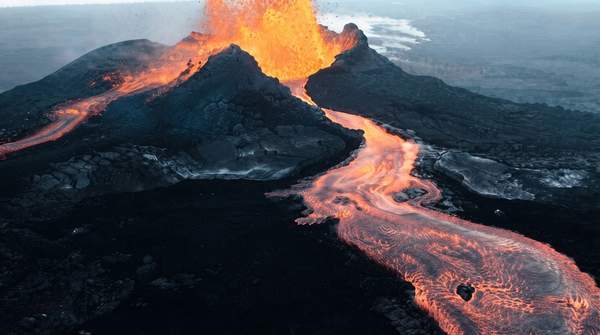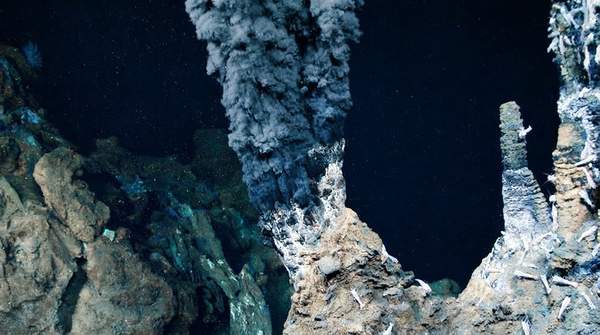
The case for life on Mars rests on two very different kinds of evidence. One looks back roughly four billion years, to massive mineral deposits in a southern basin that appear to have formed on the floor of a vanished sea. The other is happening now, or very recently: instruments aboard Europe’s ExoMars Trace Gas Orbiter have caught hydrogen chloride gas escaping from narrow fissures around Alba Mons, a signal researchers interpret as emissions from magma still lingering beneath the Martian surface. Both lines of evidence point to the same underlying ingredient—heat—and both frame Mars as a planet where the conditions associated with life’s emergence on Earth may have existed, and may still exist underground.
Mars’ Ancient Past: A Warm, Wet World with Seafloor Vents
In 2017, NASA’s Jet Propulsion Laboratory described an international report examining observations from the Mars Reconnaissance Orbiter of enormous deposits in the Eridania basin, a region of connected, quasi-circular basins in Mars’ southern hemisphere that may have originated as very ancient impacts. The study’s authors interpret the data as evidence that the deposits formed when heated water from a volcanically active part of the crust entered the bottom of a large sea, long ago.
What makes the find notable is its specificity. As JPL reported, sea-floor hydrothermal deposits add an important type of wet ancient environment to a list that already included rivers, lakes, deltas, seas, groundwater and hot springs. This is geological evidence—minerals laid down by warm, chemically reactive water at a seafloor—not a direct trace of life. But it identifies an area of Mars that may offer clues about how life originated on Earth, because it preserves the kind of environment where that origin is thought to have occurred.