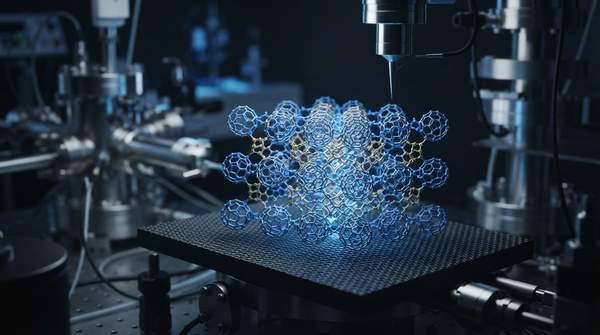
Self-assembling nanomaterials build themselves. Instead of carving structures out of bulk material, engineers design molecules whose weak interactions—hydrogen bonds, electrostatic attraction, hydrophobic effects—spontaneously organize them into ordered architectures at the nanoscale. The choice of building block, whether a peptide, a DNA strand, a block copolymer, or a small molecule destined for a surface, determines the driving force, the resulting structure, and ultimately what the material can do. Understanding that mapping is the key to engineering tunable functional materials for medicine, electronics, and energy.
Introduction to Nanoscale Self-Assembly
Self-assembly is a bottom-up strategy: rather than fabricating nanostructures feature by feature, researchers program molecules to organize themselves. A review of programmable bottom-up assembly published in 2025 describes the approach as leveraging weak interactions to impart spatially oriented direction to nanoscale materials, allowing complex architectures to form without external manipulation at every step.
The appeal is control. Because the assembly rules are written into the building blocks themselves, engineers can tune size, shape, and functionality by changing the molecular design. The building blocks span a wide range of organic and inorganic macromolecules with different masses, morphologies, chemical compositions, and functionalities—hybrid units containing crystals, colloids, nanowires, lipid bilayers, carbohydrates, peptides, proteins, and oligonucleotides, according to a review of organic and biomolecular self-assembly. Three engineering families dominate the field: biomolecular assembly, block copolymer assembly, and surface-based assembly.