AI and robotics in manufacturing are not one technology but three distinct workstreams: production and assembly, quality inspection, and logistics. Each solves a different problem, and each is concentrated in different industries. Electronics assembly leans on robots for delicate, high-precision component handling; automotive plants combine collaborative and articulated robots for mixed-model production; and logistics operations use mobile robots to move materials autonomously. This guide breaks down what each application does, where it is used, and why manufacturers are investing.
AI and Robotics in Production & Assembly
Assembly is the most established robotic territory. Putting together various parts to make a finished product is slow and error-prone when done manually, but robots streamline the process, doing it faster and more accurately, which reduces production times and errors, as Ainsley Lawrence reports in American Machinist. The result is not just speed but consistency: every unit is built to the same standard.
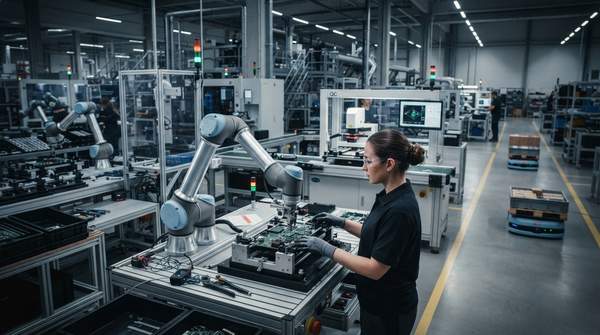
The clearest industry example is electronics. Advanced Technology Services, an industrial equipment services firm, notes that AI-powered industrial manufacturing robots are now used in electronics assembly specifically for handling delicate components with high precision. That combination—fragile parts plus tight tolerances—is exactly where human dexterity falls short of machine repeatability.
Automotive plants take a different approach. Rather than a single robot type, ATS highlights that carmakers combine cobots and articulated robots for mixed-model production. Mixed-model production means multiple vehicle variants on the same line, which demands robots that can adapt to changing workpieces rather than repeat one motion forever. AI is what makes that adaptability practical.
Automated manufacturing systems tie these pieces together. Cyngn, an autonomous vehicle technology company, describes how such systems integrate advanced control systems, computer networks, and different types of robots to optimize production, achieving precision, consistency, and speed while coordinating components seamlessly. Assembly automation, in other words, is a systems discipline, not a bolt-on arm.
Ensuring Precision: AI and Robotics in Quality Control
Quality control is where AI adds the most distinctive value, because inspection is fundamentally a perception problem. Manufacturing robots equipped with advanced vision systems are often employed to perform inspections to improve quality control, according to Lawrence's reporting. They can identify errors and defects faster and more accurately than the average human, ensuring every part of the product is exactly as it should be before it ships.
Speed matters, but consistency matters more. Oracle NetSuite, drawing on Lisa Schwarz's analysis, notes that AI systems collect detailed data throughout an item's production cycle, catching errors and defects more consistently and faster than humans can. Citing Quality Magazine, NetSuite also reports that 63% of manufacturing companies use AI for quality control, with applications expanding into real-time process optimization.
Unlike assembly, quality inspection is not tied to one dominant industry. The evidence points to broad application across manufacturing sectors, wherever product consistency must be verified before shipment. The International Federation of Robotics adds a sustainability angle: robots' ability to perform tasks with high precision reduces material waste and improves the output-input ratio of a manufacturing process, while automated systems ensure the consistent quality essential for products designed to have long lifespans and minimal maintenance.
Optimizing Movement: AI and Robotics in Logistics & Supply Chain
Logistics is the fastest-moving frontier. ATS identifies logistics and supply chain automation as a current application area, with mobile robots moving materials autonomously—work that once required forklifts, pallet jacks, and human drivers. Inside warehouses and between production stations, autonomy replaces manual material handling.
The scope extends beyond moving boxes. NetSuite's coverage describes AI being used to automate mundane and repetitive tasks, freeing employees for more complex work and safeguarding staff from dangerous jobs—for instance, robotic arms moving hot metal along an assembly line. In supply chain terms, AI algorithms analyze operational data to optimize inventory levels, predict demand, and streamline logistics, reducing costs and improving delivery times.
IBM's analysis broadens the picture further: generative AI supports manufacturing-adjacent functions such as ticket handling, call handling, market research, and the creation of product descriptions, maintenance schedules, and instructions. AI processes large volumes of documents—technical drawings, reports, records—to identify patterns and summarize key information, speeding retrieval of complex information.
There is also a strategic dimension the IFR emphasizes: compliance with UN environmental sustainability goals and corresponding regulations worldwide is becoming a requirement for supplier whitelists, and robots help manufacturers achieve those goals. Logistics automation, in this framing, is as much about resilience and market access as about speed.
Comparative Overview of AI and Robotics in Manufacturing
The table below categorizes the three application areas by their primary function, the specific tasks automated, and the industries where they are most prevalent. Use it to match a manufacturing problem to the relevant technology before evaluating vendors or pilots.
| Application Area | Key Tasks | Example Industries |
|---|---|---|
| Production & Assembly | Handling delicate components with high precision; combining cobots and articulated robots for mixed-model production; coordinating components for precision, consistency, and speed | Electronics assembly; automotive plants |
| Quality Control | Automated inspections using advanced vision systems; identifying errors and defects faster and more accurately than humans; ensuring product consistency before shipment | Applied across manufacturing sectors generally; no single dominant industry identified |
| Logistics & Supply Chain | Autonomous material movement with mobile robots; optimizing inventory levels; predicting demand; streamlining logistics to reduce costs and improve delivery times | Logistics and warehousing; manufacturing intralogistics |
The comparison shows a clear division of labor. Assembly robots deliver physical precision, quality-control robots deliver perceptual consistency, and logistics robots deliver autonomous movement. A manufacturer's first question should therefore be which of those three problems—placement, verification, or transport—constrains their operation most.
Why Manufacturers Adopt: The Business Drivers
Three drivers recur across the evidence. First, efficiency and speed: robots reduce production times and errors in assembly, and AI-driven coordination enhances overall efficiency, per both Cyngn and Lawrence's reporting. Second, cost reduction: precision reduces material waste and improves the output-input ratio of manufacturing processes, as the IFR notes, while AI-optimized logistics cuts costs and improves delivery times. Third, labor: automation frees employees for more complex work and removes them from dangerous tasks such as handling hot metal, per NetSuite's analysis.
A fourth, quieter driver is regulatory. The IFR reports that sustainability compliance is becoming a requirement for supplier whitelists, giving manufacturers a commercial reason—not just an operational one—to automate precisely.
Strategic Imperatives for Adopting Smart Manufacturing
Manufacturers should strategically integrate AI and robotics into production, quality control, and logistics to enhance efficiency, reduce costs, and address labor shortages. The decision sequence follows the table: identify whether placement, verification, or transport is the bottleneck, then match the application area—electronics-style precision assembly, vision-based inspection, or autonomous material handling—to that bottleneck.
To track where the field is heading, monitor industry reports from organizations like the IFR for trends in robot adoption rates and new application areas, particularly in the electronics and automotive sectors. Those adoption-rate reports are the measurable signal of which applications are maturing from pilot to standard practice.
Sources
- AI’s Impact on Robots in Manufacturing — Americanmachinist
- Industrial Manufacturing Robots and AI — Advanced Technology Services
- Understanding Modern Factory Automation and Industrial Robotics — CYNGN
- AI in Manufacturing: Benefits and Use Cases — Oracle NetSuite
- President’s Report by Marina Bill — IFR International Federation of Robotics
- How is AI being used in Manufacturing — IBM