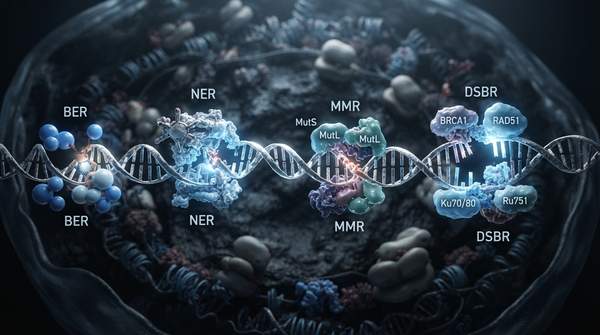
Cells survive because they can fix their own DNA. Every day, environmental agents and ordinary chemistry inside the body damage the genome, and a family of distinct repair pathways—each tuned to a different kind of lesion—removes that damage before it becomes a permanent mutation. The core answer for any student of biology: at least five major repair systems operate in mammalian cells, namely base excision repair, nucleotide excision repair, mismatch repair, homologous recombination, and non-homologous end joining, and together they are what stands between a healthy genome and cancer.
The Constant Threat to DNA: Why Repair is Essential
Living organisms are continuously exposed to DNA-damaging agents that can affect health and influence disease states, as a review of damage, repair, and mutagenesis mechanisms in Environmental and Molecular Mutagenesis puts it. Robust repair and damage-bypass mechanisms protect the DNA by removing or tolerating lesions, and when that fine-tuning fails, the result is genome instability—a feature the review links to diverse cancers where repair pathways are disrupted or deregulated.
The stakes are well established. A review in Signal Transduction and Targeted Therapy by Ruixue Huang and Ping-Kun Zhou notes that genomic instability, driven by accumulating DNA damage, is a hallmark of many cancers, and that the first direct association between DNA repair deficiency and human disease was demonstrated in xeroderma pigmentosum, a cancer-predisposing condition. When damage persists, cells may even activate programmed cell death to eliminate themselves rather than propagate an unstable genome.
Comparative Overview of Major DNA Repair Pathways
The reason a cell needs several systems rather than one is simple: damage comes in different shapes and sizes, from a single chemically altered letter to a complete severing of the double helix. The table below categorizes and contrasts the major pathways by the lesion each targets and the strategy each uses, so you can see at a glance why no single mechanism could do all the jobs.
| Repair Pathway | Type of Damage Addressed | Key Function/Mechanism |
|---|---|---|
| Base excision repair (BER) | Single altered bases, such as deaminated cytosine (uracil) | Glycosylases detect and remove the damaged base; the empty backbone segment is removed, and the gap is filled and sealed by other enzymes |
| Nucleotide excision repair (NER) | Bulky, helix-distorting lesions, such as pyrimidine dimers from UV light and large adducts from polycyclic aromatic hydrocarbons | Removes a segment of nucleotides containing the damage, followed by resynthesis and ligation |
| Mismatch repair (MMR) | Base-pairing errors introduced during DNA replication | Corrects mismatches that escape proofreading before they become fixed mutations |
| Double-strand break repair: homologous recombination (HR) | Double-strand breaks, the most deleterious form of DNA damage | Repairs breaks using a homologous template, maintaining genomic stability against severe lesions |
| Double-strand break repair: non-homologous end joining (NHEJ) | Double-strand breaks, including those induced by ionizing radiation | Joins broken DNA ends directly; unrepaired DSBs can lead to genomic instability, cell-cycle arrest, and cell death |
These five pathways are active at different stages of the cell cycle, according to the Environmental and Molecular Mutagenesis review, and a few specific lesions can also be removed by direct chemical reversal and interstrand crosslink repair. When even these systems cannot finish the job, damage-tolerance pathways let replication continue past a lesion—at the risk of fixing an error as a mutation.