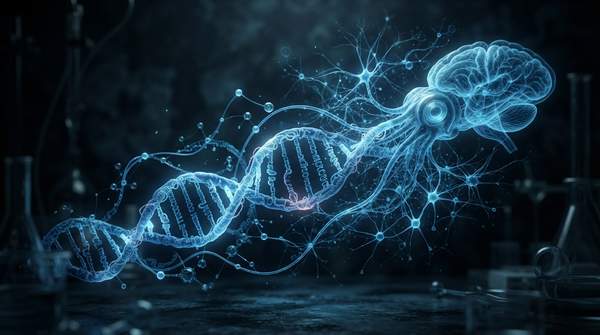
Octopuses, squid, and cuttlefish are evolutionary marvels, possessing nervous systems of a size and complexity unparalleled among invertebrates. Their ability to solve problems, learn, and execute sophisticated camouflage has long fascinated scientists. A study from researchers at the University of Vienna proposes a novel explanation for the origins of this remarkable intelligence, suggesting the answer lies not just in their genes, but in the physical, three-dimensional folding of their DNA. This hypothesis posits that the unique 3D architecture of the cephalopod genome was not a passive outcome of evolution, but an active force that helped drive the development of their elaborate brains.
This perspective challenges a long-held view of genome architecture as a simple container for genetic information. Instead, the research suggests that the way DNA is organized in space can create new evolutionary possibilities. In cephalopods, an ancient reorganization of their genome may have unlocked a vast landscape of regulatory combinations, providing the raw material for natural selection to build complex traits, particularly those related to the nervous system.
The Two-Tiered System of Genome Organization
To understand how genome structure can influence evolution, researchers examined its organization at different scales. They discovered a two-part system within the cephalopod genome that masterfully balances the need for stability with the potential for innovation. At a large scale, the genome is partitioned into stable, conserved blocks that protect essential biological functions. At a finer scale, a much more dynamic system of connections allows for genetic experimentation. This dual structure appears to be a key feature that enabled cephalopods to evolve their unique complexity while maintaining the functions necessary for survival.
The foundation of this system consists of large structural units known as chromatin domains. According to the research, these domains remained remarkably stable over evolutionary time, even as the genome underwent significant reorganization. This stability is crucial, as it likely preserves the core functions of the genome, ensuring that fundamental biological processes are not disrupted. By anchoring essential gene relationships, these domains provide a reliable framework upon which more complex and novel traits can be built without risking catastrophic failure.
In contrast to this stable foundation, the genome also features a network of finer-scale connections called chromatin loops. These loops are far more dynamic and variable. Within the nucleus, DNA is folded into a complex structure, and these loops bring distant regions of the DNA into close physical contact. This allows regulatory elements, such as enhancers, to influence genes that may be located very far away along the linear chromosome. Unlike the stable domains, these loops were found to vary widely across different cephalopod species, between different tissues, and even at different developmental stages, highlighting their role as a flexible and adaptable component of the genome.
Cephalopod Genome Architecture: Stable Domains vs. Dynamic Loops
The interplay between the stable, large-scale chromatin domains and the flexible, fine-scale chromatin loops forms the basis of the hypothesis explaining cephalopod brain evolution. The following table contrasts these two structural components, clarifying their distinct characteristics and proposed roles in driving evolutionary change.
| Structural Component | Key Characteristics | Role in Gene Regulation | Hypothesized Evolutionary Impact |
|---|---|---|---|
| Large Chromatin Domains | Large, structural units of the genome that remained remarkably stable over evolutionary time. | Their stability is thought to maintain essential, core genomic functions, protecting them from disruption. | By preserving fundamental biological processes, they provide a stable foundation upon which new traits can evolve. |
| Fine-scale Chromatin Loops | Smaller connections that are far more dynamic, varying widely across species, tissues, and developmental stages. | They bring distant regions of DNA into physical contact, allowing regulatory elements to influence genes located far away on the chromosome. | This flexibility creates new regulatory possibilities and provides the raw material for the evolution of novel traits, particularly those related to the nervous system. |
Regulatory Entanglement: A Driver of Innovation
The dynamic interaction between stable domains and flexible loops creates a phenomenon that the researchers termed "regulatory entanglement." This process allows the genome to generate new patterns of gene expression, effectively creating a playground for evolution to test new biological functions. By forming new chromatin loops, the genome can bring a regulatory element into contact with a new target gene, potentially altering when, where, or how much that gene is expressed. This creates a novel regulatory combination that natural selection can then act upon.
Crucially, this entanglement allows for innovation without jeopardizing stability. Because the large chromatin domains keep essential functions intact, the genome can "tinker" with gene regulation via the dynamic loops without breaking core biological machinery. This balance may have been instrumental in providing the raw material for the evolution of traits as demanding as a large, distributed nervous system. The 3D organization of DNA, in this view, actively influences which regulatory combinations become available for evolution to work with, shaping the trajectory of a species.
The Genomic Blueprint for a Complex Nervous System
The study provides a compelling link between this unique genomic architecture and the evolution of cephalopods' advanced brains. Researchers discovered that the highly dynamic chromatin loops were frequently found near genes involved in key cephalopod traits, with a specific concentration around genes linked to the nervous system. This finding suggests that the flexibility afforded by these loops was particularly impactful in shaping the development and function of neural circuits.
The ability to create new regulatory connections for these specific genes may have allowed for the fine-tuning and elaboration of the nervous system over evolutionary time. This could have contributed to the emergence of the exceptionally large and structured brains seen in modern octopuses, squid, and cuttlefish. The 3D structure of DNA, therefore, appears to have played a direct and active role in building one of the most complex minds in the animal kingdom, challenging the idea that genome architecture is merely a passive consequence of evolutionary pressures.
Understanding the Genomic Drivers of Complexity
The findings on cephalopod genomes suggest a paradigm shift in how we view the role of DNA's physical structure in evolution. The research proposes that the three-dimensional organization of the genome is not just a passive outcome of other evolutionary processes but can be an active and powerful driver of change itself. In the case of cephalopods, this dynamic architecture may have opened up an enormous space of new regulatory possibilities, directly fueling the evolution of their unique biological complexity.
Based on this hypothesis, the reader should recognize that the 3D organization of the genome is not merely a passive outcome but an active driver of evolutionary innovation, particularly in complex traits like the cephalopod brain. The validation of this model will depend on future studies, with a key measurable indicator being further research identifying specific gene expression changes driven by dynamic loops in neural development across different cephalopod species.
Sources
- 3D structure of DNA may explain how cephalopods evolved complex brains — Universität Wien
- Genome reorganisation and expansion shape 3D genome architecture and define a distinct… — Nature
- 3D Cephalopod DNA Structure Drives Brain Evolution — SFLORG
- Ancient DNA Reorganization May Explain How Octopuses Grew Such Complex — BIOENGINEER.ORG
- 3D structure of DNA may explain how cephalopods evolved complex brains — EurekAlert!
- 3D genome 'entanglement' may explain how cephalopods evolved complex brains — Phys.org