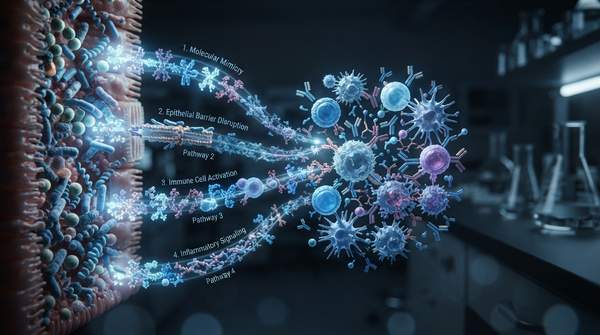
When the gut microbiome falls out of balance, it can help drive autoimmune disease through four main routes: molecular mimicry, leakage of bacterial products through a weakened intestinal barrier, shifts in T-cell differentiation, and changes in the metabolites bacteria produce. Scientific reviews of the microbiome–immune axis describe how these pathways converge on the same destination — the loss of immune tolerance and the activation of self-reactive immune cells that attack the body's own tissues.
The evidence for this picture comes from several published syntheses of the field, including a 2025 review of immune signaling in autoimmune disease and reviews of the emerging role of gut microbiota in conditions such as lupus and rheumatoid arthritis. Together they show that the microbiome is not a bystander but what one review calls "a dynamic regulator of immune signaling."
Introduction: The Gut Microbiome and Autoimmunity
Why would bacteria living in the digestive tract have any say in whether the immune system attacks its own host? The answer is proximity and chemistry. The gut houses an enormous microbial community that sits in constant contact with the immune tissue lining the intestine. That contact is not passive: reviews of the field describe the gut microbiota as a dynamic regulator of immune signaling, shaping how immune cells develop, communicate, and decide what counts as a threat.
Most of the time, that relationship is managed. The immune system maintains tolerance toward both the body's own proteins and the commensal bacteria that coexist with us. Autoimmune disease begins when that tolerance breaks. Reviews covering conditions from systemic lupus erythematosus to rheumatoid arthritis converge on the same four-part account of how microbes contribute to that break — and, importantly, how some microbial factors protect against it.
Mechanism 1: Molecular Mimicry — Confusing Friend for Foe
Molecular mimicry is the most conceptually direct route to autoimmunity. The logic is simple: if a microbe carries structures that resemble one of the body's own proteins, then immune cells trained to fight that microbe can end up attacking the look-alike tissue as well.
This is not purely theoretical. A review on the emerging role of gut microbiota in autoimmune disease documents that certain gut microorganisms harbor epitopes — the molecular fragments immune receptors recognize — that resemble host proteins. The clearest example is the RNA-binding protein Ro60 in systemic lupus erythematosus. When microbes carry Ro60-like epitopes, they can activate T and B cells that then cross-react with the body's own Ro60. The result, the review describes, is an abnormal adaptive immune response and the production of pathogenic autoantibodies — the self-directed antibodies that characterize lupus.
The chain of events is worth tracing explicitly. A microbe presents a look-alike fragment; the immune system mounts a response against it; the same response recognizes the host's native protein; and tolerance to that protein is broken. Autoimmunity here begins as an ordinary immune reaction that misses its target.
Mechanism 2: Intestinal Barrier Disruption and Immune Activation
The second pathway depends on location. The intestinal barrier normally keeps bacterial components contained, but reviews describe how dysbiosis — a disruptive shift in microbial composition — can be accompanied by impaired barrier function. A more permeable barrier allows bacterial products, including the potent inflammatory molecule lipopolysaccharide (LPS), to reach immune tissue and circulation.
What happens next is well described in reviews of systemic immunity. The immune system detects such microbial products through pattern recognition receptors, particularly toll-like receptors (TLRs), which bind molecules like LPS. That binding activates inflammatory pathways. From there, the cascade continues into dendritic cell and T-cell activation — and the evidence links that activation to autoimmune induction.
The significance of this pathway is scale. Molecular mimicry requires a specific look-alike antigen, but barrier disruption converts any local microbial imbalance into a systemic immune stimulus. Once bacterial products translocate, the immune system reacts to them wherever they travel, and the same TLR-driven activation can promote inflammation well beyond the gut.
Mechanism 3: Modulating T-Cell Differentiation
The third pathway is subtler because it does not involve a foreign molecule crossing into the body at all. Instead, it works through instruction: the microbiome shapes which types of immune cells the body develops.
Reviews of immune signaling describe how microbial products influence T-cell differentiation — the process by which immature immune cells commit to particular functional identities — and the cytokine profiles those cells release. This matters because T cells are not interchangeable. A review describing the role of Th9 cells and the signaling molecule IL-9 in ulcerative colitis illustrates how one T-cell subset can compromise tolerance to commensal bacteria by inducing inflammation, impairing barrier function, and interfering with mucosal wound healing.
The balance at stake is between tolerance and attack. The evidence frames regulatory immune activity as critical for maintaining tolerance to both host tissue and commensal bacteria, while inflammatory T-cell activity pushes the system toward autoimmune responses. The microbiome sits upstream of that decision. Shift the T-cell population toward inflammatory subsets and away from regulatory ones, and the immune system becomes progressively less able to leave its own tissues alone.
Mechanism 4: Microbial Metabolites — Chemical Messengers of the Gut
The fourth pathway is chemical. Bacteria do not only interact with the immune system through their structural components or by crossing barriers — they also release metabolic by-products that act on immune cells directly.
The best-described examples are short-chain fatty acids (SCFAs), produced when bacteria ferment dietary fiber. A 2025 review of immune signaling in autoimmune disease reports that these bacterial fermentation products exert immunomodulatory effects by influencing T-cell differentiation and cytokine profiles. Rather than triggering inflammation, SCFAs support defensive immune functions and tolerance — a regulatory influence that runs opposite to LPS-driven activation.
This pathway is also where therapeutic ambition is concentrated. The same review points to emerging strategies targeting microbial restoration — precision probiotics, microbiota transplantation, and tailored nutritional interventions — all aimed at restoring immune balance by reshaping what the microbiome produces. The logic follows the mechanism: if metabolites regulate immune cells, then changing the metabolite producers can change immune behavior.
Explanatory Model: How Gut Microbes Influence Autoimmunity
The model below traces each causal chain from its specific microbial trigger, through the immune interaction it provokes, to the resulting outcome relevant to autoimmunity. Use it to see how four distinct entry points — a look-alike antigen, a leaked bacterial molecule, a T-cell instruction signal, and a fermentation product — converge on the same immunological stakes.
| Pathway | Microbial trigger or factor | Immune interaction | Autoimmune-relevant outcome |
|---|---|---|---|
| Molecular mimicry | Gut microorganisms harbor epitopes resembling host proteins, such as the RNA-binding protein Ro60. | Cross-activation of self-reactive T and B cells. | Abnormal adaptive immune responses and production of pathogenic autoantibodies, documented in systemic lupus erythematosus. |
| Barrier disruption and TLR activation | Impaired intestinal barrier function allows bacterial components, including LPS, to translocate. | Toll-like receptors bind LPS and activate inflammatory pathways, leading to dendritic-cell and T-cell activation. | Systemic inflammation and autoimmune induction. |
| T-cell differentiation | Microbial signals shape which immune-cell subsets the body develops. | Altered T-cell differentiation and cytokine profiles; Th9 cells and IL-9 can induce inflammation and compromise tolerance to commensal bacteria. | A shift from immune tolerance toward inflammatory, autoimmune responses. |
| Metabolite production | Bacterial fermentation products, including SCFAs. | SCFAs exert immunomodulatory effects on T-cell differentiation and cytokine profiles. | Support for defensive immune functions and tolerance — a counterweight to the inflammatory pathways. |
Read down the first column and the routes look separate. Read across any row and the pattern repeats: a microbial input becomes an immune instruction, and that instruction either preserves or erodes tolerance. The pathways also interact in practice — a leaky barrier exposes the immune system to mimics and LPS, while metabolite shifts determine whether the resulting T-cell response leans regulatory or inflammatory.
Pro-inflammatory vs. Anti-inflammatory Microbial Factors
The comparison below makes the microbiome's two-sided nature concrete. The same ecosystem contains factors that provoke autoimmune-relevant inflammation and factors that suppress it.
| Factor | Direction | Documented effect |
|---|---|---|
| Lipopolysaccharide (LPS) | Pro-inflammatory | Binds to TLRs and activates inflammatory pathways, leading to dendritic-cell and T-cell activation. |
| Short-chain fatty acids (SCFAs) | Anti-inflammatory / regulatory | Influence T-cell differentiation and cytokine profiles, supporting defensive functions and immune tolerance. |
| Prevotella strains | Pro-inflammatory (animal evidence) | In studies of collagen-induced arthritis, colonization of germ-free mice with specific Prevotella strains induced or worsened arthritis symptoms. |
The Prevotella finding requires careful qualification: it comes from animal models, not human patients. In the widely used collagen-induced arthritis model of rheumatoid arthritis, germ-free mice are actually resistant to disease, whereas colonization with specific Prevotella strains can induce or exacerbate arthritis symptoms in those animals. That establishes a plausible mechanism and a research direction — not proof that Prevotella causes arthritis in humans.
This dual character explains why the field's therapeutic interest is not in eliminating gut bacteria but in rebalancing them. The goal is to shift the ecosystem away from its pro-inflammatory outputs and toward the regulatory ones the evidence identifies.
Two boundaries should also be stated plainly. This article explains general mechanisms; it does not offer medical advice or treatment recommendations for any specific autoimmune condition. And it does not catalog every bacterium linked to autoimmunity — that remains an active, unsettled research area, with organisms, pathways, and conditions including rheumatoid arthritis, multiple sclerosis, and lupus still under investigation.
Conclusion: The Intricate Balance of Gut and Immunity
What ties these four pathways together is a single idea: the gut microbiome is an active participant in immune regulation, not a background presence. Its members can present molecular mimics that redirect immune attacks, leak inflammatory products through a weakened barrier, steer T-cell development toward or away from tolerance, and release metabolites that either calm or inflame immune responses.
The four mechanisms give readers a checklist for understanding any new study in this field: ask which pathway it implicates, whether the evidence comes from humans or animal models, and whether the microbial factor in question is pro-inflammatory or regulatory. Those three questions distinguish well-supported claims from speculative ones.
Monitoring Gut Health for Immune Balance
Individuals concerned about autoimmune conditions should consider factors influencing gut microbiome health, such as diet and lifestyle, as these can modulate immune responses. All four pathways traced above respond to the composition and output of the microbial community, and the therapeutic strategies now under development — from precision probiotics to tailored nutrition — are built on precisely that premise.
The practical checkpoint is measurable: changes in gut microbial composition or metabolite profiles, as indicated by future diagnostic tests, could signal shifts in immune regulation relevant to autoimmune disease progression. Until such tools reach routine clinical use, the honest position is that the mechanisms are well described, the microbial factors are partially identified, and researchers are still mapping exactly which microbes tip which pathways — in humans rather than mice.