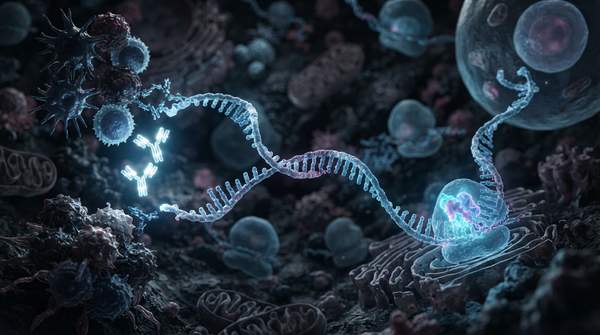
The term "junk DNA" is a misnomer. Most of the human genome does not encode proteins—protein-coding genes make up only about 3% of it—yet the Encyclopedia of DNA Elements (ENCODE) project found that at least 75% of the genome is transcribed into RNA. Decades of research since have shown that these non-coding regions regulate when and where genes are switched on, hold chromosomes together inside the nucleus, and may even drive the evolution of new species. Understanding why scientists got it wrong, and what the "junk" actually does, is one of the great revision stories in modern biology.
The Misnomer of 'Junk DNA'
Why did scientists dismiss most of our genome in the first place? The answer lies in what genomicists call a protein-centered bias. DNA contains genes, and genes encode proteins, which direct most of the body's functions. Early gene discovery was essentially a hunt for needles in a haystack, as University of Colorado Anschutz researcher Kara Mason's interviewee puts it—and few researchers were interested in the haystack itself. Non-coding stretches were thus coined "junk DNA" by some working in genomics a few decades ago.
Formally, "junk DNA" came to mean DNA with no positive impact on an organism's fitness. Under that definition, any DNA that didn't make a protein—and any RNA transcribed from it—was assumed to be functionless "noise." This view prevailed for decades among some genomicists. Yet, as a review of the concept notes, biochemical functions have since been identified for an increasing fraction of the DNA elements traditionally seen as junk, a re-evaluation that is ongoing as more functions are discovered.
ENCODE Project: A Paradigm Shift
The turning point came around 2012. The ENCODE consortium used multi-omics data to declare the "death of junk DNA," a conclusion that was met with much fanfare and publicized by high-profile journals including Nature, Science, and The Lancet. The project's headline finding was staggering in its proportions: at least 75% of the human genome is transcribed into RNA, while protein-coding genes account for just 3%.
That single comparison reframed the debate. If three-quarters of the genome is copied into RNA, the idea that all those transcripts were meaningless noise became hard to sustain. As researchers writing on long non-coding RNA in cancer genetics put it, regions transcribed into non-coding RNAs had been viewed as junk and their transcription as noise "lacking biological meaning"—a characterization the ENCODE data significantly re-evaluated. The project did not settle every question about function, but it permanently shifted the burden of proof toward taking non-coding DNA seriously.