Quantum computers can be built from very different physical systems, and the two leading approaches—superconducting circuits and trapped ions—embody opposite engineering philosophies. Superconducting qubits are fast but harder to keep accurate and connect. Trapped-ion qubits are highly accurate and fully connected, but slower and harder to scale. Neither is definitively better; each represents a distinct bet on how to reach fault-tolerant quantum computing.
Superconducting Qubits: Artificial Atoms for Speed
What do you actually build a qubit from? The superconducting approach answers: from human-made circuits. As Alvaro Ballon explains in a PennyLane technical tutorial, superconducting quantum computing is "based on artificial versions of atomic systems done using superconducting circuits, which allows for versatility and control." Engineers craft tiny circuits from superconducting materials that behave, quantum mechanically, like controllable atoms.
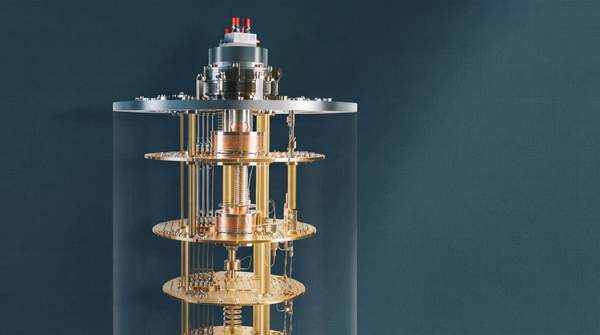
These circuits must be kept extremely cold. The transmon qubits at the heart of today's superconducting processors need to sit at very low temperatures, which requires large cryogenic devices known as dilution refrigerators. At such temperatures, electrical resistance vanishes and currents flow without energy loss, letting the circuit hold its delicate quantum state.
The payoff is speed. Superconducting qubits perform quantum gates in nanoseconds, significantly faster than trapped-ion qubits, as SpinQ's overview of the field notes. Fabrication techniques borrowed from the semiconductor industry can also be adapted to produce many qubits efficiently, which is why companies such as Google, IBM, and Amazon have invested heavily in this architecture.
The cost is fragility. Superconducting qubits are extremely sensitive to their environment, and decoherence destroys superposition, causing information loss. Increasing qubit coherence time and the speed of quantum operations and measurements remains, in Ballon's words, essential to scaling the technology further.
Trapped-Ion Qubits: Natural Atoms for Fidelity
The trapped-ion approach takes the opposite route: instead of manufacturing an artificial quantum system, it borrows one from nature. IonQ, a leading developer of the technology, describes using "a naturally occurring quantum system: individual atoms," which form the heart of its quantum processing units.
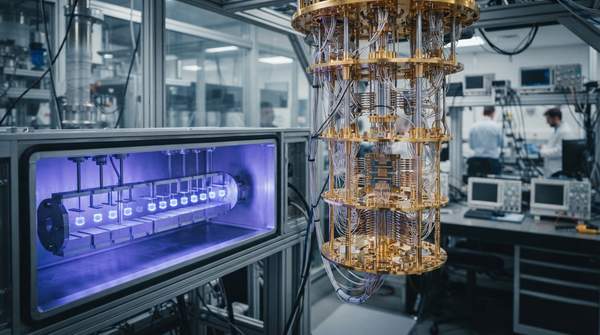
The atoms are suspended—trapped in three-dimensional space—and then manipulated with lasers. Lasers handle everything from initial preparation to final readout, a process IonQ notes demands precision optical and mechanical engineering and fine-grained firmware control. Cooling is applied to the ions themselves rather than to surrounding hardware: using Doppler cooling, IonQ creates qubits at half of one one-thousandth of a degree above absolute zero.
The advantage of using real atoms is uniformity and control. Because every ion of a given element is identical, trapped-ion qubits start out as very good physical qubits. Mete Atatüre, head of the Cavendish Laboratory at the University of Cambridge and leader of its IonQ partnership, put it plainly: "What trapped ions offer is the cleanest, most beautiful qubits."
But the same isolation that makes ions pristine makes them slow to manipulate and hard to move around. As Atatüre observed of the approach's trade-offs, "Trapped ions are great to begin with, but moving them around is a challenge."
Key Trade-offs: Speed, Fidelity, and Coherence
How do the two architectures stack up on accuracy? In a comparison of modalities based on two-qubit gate fidelity—a measure of accuracy—trapped ions scored 99.91%, compared to 99.7% for superconducting qubits. Each fraction of a percentage point matters: classical computers achieve fidelities exceeding 99.999%, so every gap between quantum and classical hardware must be closed through error correction.
That correction is expensive. All quantum computing efforts fabricate many more physical qubits than the logical qubits that end up being useful, because many qubits deteriorate when exposed to noise. Here trapped ions hold an edge: because they "start out as very good physical qubits," as Atatüre noted, a trapped-ion machine might need fewer of them to build good logical qubits.
Superconducting qubits counter with raw speed. A gate that finishes in nanoseconds can be repeated many times, and errors can be corrected quickly—provided the qubits stay coherent long enough. The two architectures thus push on opposite doors: one optimizes for fast, manufacturable hardware that must fight decoherence; the other for pristine, long-lived qubits that must overcome slowness and the difficulty of scaling.
Qubit Connectivity and Algorithmic Performance
Connectivity may matter as much as clock speed and gate fidelity when building large-scale quantum computers. That claim isn't theoretical: researchers at Duke University's ion trap laboratory ran several quantum algorithms on two 5-qubit programmable quantum computers—their fully-connected ion trap system and IBM's superconducting system.
The results mirrored the connectivity of each system. The ion trap machine outperformed the superconducting system on all results, but particularly when the algorithm demanded more connections between qubits.
Why does this happen? In a superconducting processor, qubits are typically wired to only a few nearest neighbors, so an operation between distant qubits must be routed through intermediaries, adding overhead and noise. In a trapped-ion system, as IonQ explains, qubits "aren't connected by physical wires, so every qubit can interact with every other with no intermediary steps," reducing communication overhead and, by extension, computational noise. For algorithms with dense interaction patterns, that difference compounds quickly.
Superconducting vs. Trapped-Ion Qubits: A Comparative Overview
The table below juxtaposes the defining characteristics of each architecture across the key performance and engineering dimensions, making the inherent trade-offs visible at a glance.
| Dimension | Superconducting Qubits | Trapped-Ion Qubits |
|---|---|---|
| Physical basis | Artificial atoms: superconducting circuits engineered to behave as quantum systems, kept at very low temperatures in dilution refrigerators | Natural atoms: individual atomic ions trapped in 3D space and manipulated with lasers for preparation, gates, and readout |
| Gate fidelity | Generally lower; reported two-qubit gate fidelity of 99.7% | Generally higher; reported two-qubit gate fidelity of 99.91% |
| Gate speed | Very fast—gates performed in nanoseconds, significantly faster than trapped ions | Slower gate operations than superconducting qubits |
| Qubit connectivity | Limited; qubits typically connected to a few nearest neighbors, adding routing overhead | Fully connected; every qubit can interact with every other with no intermediary steps |
| Primary scalability challenges | Decoherence and environmental sensitivity; large cryogenic infrastructure; improving coherence times and operation speed | Moving and controlling many ions is difficult; slower gates; complex precision optical engineering |
Read together, the rows reveal the core pattern: superconducting qubits buy speed and manufacturability at the price of fidelity, connectivity, and cryogenic complexity, while trapped-ion qubits buy fidelity and full connectivity at the price of speed and harder scaling.
Navigating the Quantum Hardware Landscape
Organizations pursuing quantum computing must weigh the inherent trade-offs between superconducting and trapped-ion architectures based on their specific application needs, considering factors like required gate speed, error tolerance, and algorithmic connectivity. A workload with dense qubit interactions favors the fully-connected ion trap; one that rewards rapid, repeated operations favors superconducting speed. Neither choice is wrong—they are different points on the same engineering frontier.
What should you watch to see how this landscape evolves? The continued investment and research breakthroughs in both superconducting and trapped-ion technologies, alongside the development of hybrid systems, will indicate the evolving landscape and potential convergence or specialization of these platforms. The measurable indicators are concrete: closing the fidelity gap toward classical hardware's 99.999%+, lengthening coherence times, and demonstrating larger fully-connected or efficiently-routed systems. Whichever architecture moves those numbers fastest will shape the next decade of quantum computing.